How to Pick a Ripe Honeydew Melon

Sep 20, 2026
This post may contain affiliate links. Please read our disclosure policy.
Few things beat biting into a perfectly ripe, juicy honeydew melon — but picking the right one at the store can feel like a guessing game. The good news? A few simple checks are all you need to find a melon that’s sweet, ripe, and ready to eat.
Today I will walk through what makes honeydew so good for you, when it’s in season, how to tell if one is ripe, and the best ways to cut, store, and even freeze it so nothing goes to waste.
Signs Of A Ripe Honeydew Melon
Not sure how to tell if that honeydew melon at the store is actually ready to eat? Here’s exactly what to look, feel, and smell for:
Color: Look for skin that’s a creamy, pale yellow — almost like the color of butter. Green patches or a greenish-white tint usually mean the melon needs more time to ripen. The more uniform and golden the skin, the more likely the melon is mature and ready to eat.
Texture: Run your hand over the surface. Ripe honeydew has a subtle waxy feel, almost like a light coat of wax on the skin. Avoid melons that feel rough, fuzzy, or overly matte — those are often underripe.
Feel (Weight): Pick the melon up and compare it to others of similar size. A ripe honeydew will feel surprisingly heavy for its size — that extra weight is a sign of the high water content and juicy flesh inside. A lighter melon may be underripe or starting to dry out.
Stem End: Find the small, slightly indented spot where the melon was attached to the vine (opposite the more rounded blossom end). Press it gently with your thumb. It should give just a little, similar to pressing the tip of your nose. If it’s rock-hard, it needs more time; if it feels mushy or soft all over, it may be overripe.
Aroma: Bring the melon close and take a sniff near the stem end. A ripe honeydew will have a subtle, sweet, floral scent. If you can’t smell anything at all, the melon likely needs more time to ripen. If the smell is strong, sour, or fermented, skip it — that’s a sign it’s overripe or starting to spoil.
A quick tip: No single sign is foolproof on its own, but when a melon checks off most or all of these boxes — pale color, slightly waxy texture, good weight, a little give at the stem, and a sweet aroma — you can feel confident you’ve picked a delicious, ripe melon.
What Is A Honeydew Melon?
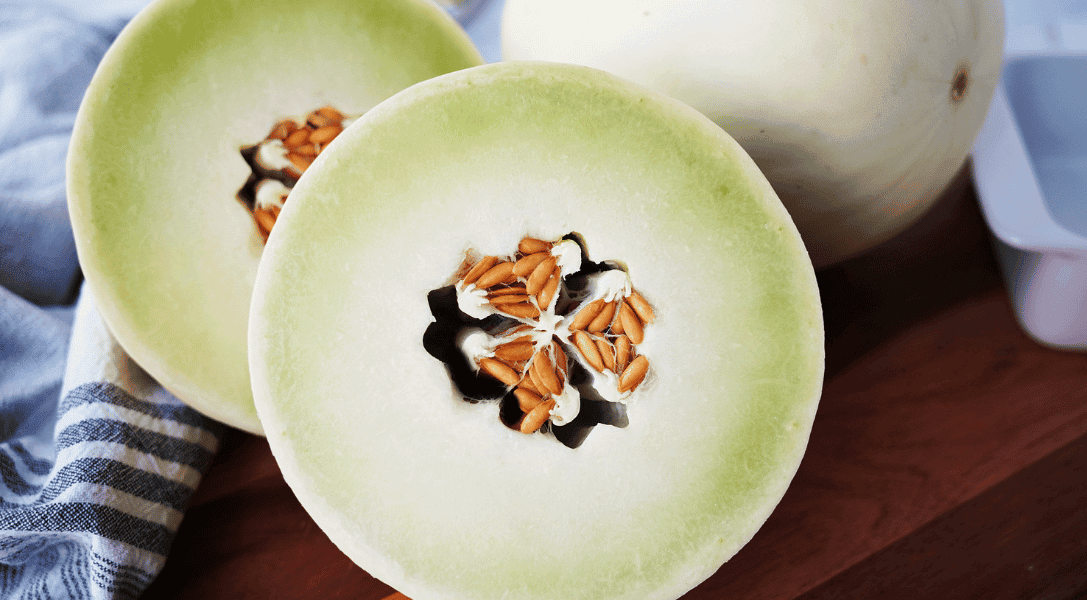
A honeydew melon is a sweet, juicy fruit that is part of the cantaloupe family. It has smooth, pale yellow or greenish skin. And it has a sweet, light green flesh inside.
Honeydew is known for its refreshing flavor and high water content. It is often enjoyed fresh in fruit salads, smoothies, or as a healthy snack.
Honeydew melon is a sweet, refreshing fruit in the same family as cantaloupe. It has smooth, pale yellow-to-green skin and pale green flesh inside with a light, honey-like sweetness.
Honeydew is loved for its high water content and crisp, refreshing bite, making it a favorite in fruit salads, smoothies, and healthy snacking. It’s also a good source of vitamin C, vitamin B6, potassium, and antioxidants — especially when it’s fully ripe.

What Percentage Water Is Honeydew Melon?
A honeydew melon is approximately 90% water making it a great source of hydration.
Related: Hydrating Fruits and Vegetables
When Is Honeydew Melon In Season?
Honeydew melon is typically in season from late spring through early fall, with peak availability from June to September. During this time, you’ll find the freshest, ripest melons at markets. However, thanks to import markets, you are able to enjoy honeydew melon year round.
What if the Melon Isn’t Ripe Yet?
Don’t worry — an underripe honeydew doesn’t have to stay that way. Simply leave it on the counter at room temperature for a few days, and it will continue to ripen. To speed up the process, place it in a paper bag with an apple or banana; these fruits release natural ethylene gas, which helps the melon ripen faster. Just be sure to check on it daily so it doesn’t go from underripe to overripe overnight.
Can You Freeze Honeydew Melon?
Yes, you can freeze honeydew melon to enjoy at a later time. Please check out our tips and tricks:
Prep. Wash and cut up the honeydew melon into your desired cut (slices, chunks, diced, etc.).. Cut into slices, small chunks, or Next, let the honeydew pieces dry out for about 15 minutes. You can also pat them dry with a paper towel to speed up the process
Pre-freeze. Line a baking sheet with parchment paper or a silicone mat. Spread out the chunks of melon in a single layer. Then, put the baking sheet in the freezer for 2 to 3 hours or until the fruit pieces freeze solid.

Transfer. Take the baking sheet out of the freezer, and transfer the fruit into a freezer bag. Squeeze out any extra air. Remember to label the bag with a date.
Freeze. Place in your freezer. It can last for up to one year.
Ways To Enjoy Honeydew Melon
- Hazelnut Fruit Salad
- Melon Sorbet Float
- Cucumber Melon Salad
- Ice Cream Cone Fruit Salad
- Fruit Salad Bowl
For more honeydew melon recipes and ideas, follow us on Pinterest and Instagram.