Louisiana Agriculture

Aug 18, 2026

This post may contain affiliate links. Please read our disclosure policy.
Before European settlers set foot in the region, Indigenous peoples cultivated early corn, beans, and squash along the nutrient-dense floodplains of the Mississippi River Delta. Agricultural shifts began in the 18th century as French and Spanish colonists introduced commercial cash crops.
Sugarcane was brought to Louisiana in 1751. It became a major economic driver following refinement breakthroughs in 1795. However, early agricultural expansion relied heavily on forced slave labor to establish vast cotton and sugarcane plantations.
The Civil War disrupted this economy. The post-war era transformed the land into sharecropping systems and saw the rise of iconic specialty crops, such as rice in the southern prairies and tobacco along the Mississippi River.
The 20th century introduced mechanization, reshaped rural labor, and diversified farming operations. Today, Louisiana’s agricultural sector generates over $4.8 billion in market sales annually. It is spread across nearly 25,000 farms covering roughly 8 million acres.
Louisiana also occupies a distinct niche in American food production through its commercial fisheries and aquaculture. It produces 25% of the nation’s seafood. Louisiana leads the country in crawfish output by supplying over 100 million pounds per year. It also ranks among the top producers of shrimp, oysters, and farm-raised alligators.
Geographically, the state serves as a trade hub, with ports along the lower Mississippi River moving roughly 60% of all U.S. grain exports overseas. While modern farmers increasingly adopt precision technologies and sustainable practices, family farms which account for nearly 85% of operations continue to blend traditional cultural heritage with global market demand.
About the Louisiana Department of Agriculture & Forestry
The Louisiana Department of Agriculture and Forestry (LDAF) is the state executive agency dedicated to promoting, protecting, and advancing Louisiana’s agricultural and forestry industries. It is led by an elected Commissioner of Agriculture and Forestry. The department oversees multi-billion-dollar sectors that power the state’s rural economy.
LDAF handles a diverse range of responsibilities from protecting soil and water resources and managing state forestlands to preventing wildfire hazards and enforcing animal health standards. Additionally, the department helps local growers expand into new markets by promoting Louisiana-grown products locally, nationally, and internationally.
Beyond assisting farmers and timber producers, LDAF plays a direct role in everyday consumer protection and public safety across the state. The department monitors gas pumps and commercial scales for accuracy, inspects food processing facilities to safeguard the food supply, and regulates pesticides, seeds, and fertilizers to ensure product quality and environmental safety.
LDAF also manages agricultural assistance programs, supports disaster response for livestock and pets during emergencies, and provides technical assistance to private landowners. Through these combined regulatory and supportive roles, LDAF balances economic growth for agricultural producers with health and safety standards for the general public.
Learn more at https://www.ldaf.la.gov/.
Top 5 Agricultural Commodities in Louisiana
Louisiana’s agriculture is as rich and diverse as its culture. It is shaped by the fertile delta soils, subtropical rainfall, and generations of farming tradition. Beyond feeding local communities, the state’s fields, forests, and waterways produce foundational staples and specialty goods that reach dinner tables, building sites, and manufacturing plants across the nation and around the globe.
Timber & Forestry
Forestry is Louisiana’s single largest land-use agricultural sector, covering roughly 14 million acres, which is over half the state. The industry generates nearly 3.85 billion dollars in economic value annually. It provides raw timber, paper products, and building materials to domestic and export markets. More than 80% of Louisiana’s forestland is privately owned by individuals and families rather than large corporations.
Poultry (Boilers)
Poultry is Louisiana’s largest animal agricultural sector, generating nearly $1 billion annually for the state economy. Centered primarily in northern and central parishes, hundreds of family-owned farms raise broilers that supply fresh chicken to dinner tables and restaurants nationwide. Beyond boosting rural employment, the industry supports local grain farmers by driving consistent demand for animal feed crops like corn and soybeans.
Sugarcane
Louisiana is the top producer of sugarcane in the United States. They compete closely with Florida. Sugarcane is cultivated primarily across the southern delta parishes. It generates over $1 billion annually for the state economy and supplies refined sugar to consumer brands nationwide. Louisiana has been growing sugarcane commercially for over 200 years, making it one of the oldest continuously grown crops in North America.
Cattle and Calves
Cattle and calves represent one of Louisiana’s most widespread livestock industries. It has cattle farms operating in every single parish across the state. It generates hundreds of millions of dollars annually. Plus, the sector supports thousands of local ranchers while utilizing pasturelands unsuited for row crops. Most Louisiana calves are raised on family-owned pastures before moving into national supply chains to feed beef markets across the country.
Aquaculture
Aquaculture is a massive pillar of Louisiana’s agricultural economy. It generates hundreds of millions of dollars annually. Louisiana is among the top producers of farm-raised seafood in the nation. By utilizing flooded fields and coastal waters, local producers raise high-value aquatic species that supply seafood markets, restaurants, and grocery stores across the country. This specialized industry plays a critical role in supporting thousands of rural coastal jobs while preserving Louisiana’s unique culinary traditions. Some of the top aquaculture commodities include crawfish, farm-raised alligators, catfish and oysters.
Fruits and Vegetables from Louisiana
Louisiana’s warm subtropical climate, fertile alluvial soils, and long growing season create ideal conditions for a wide array of specialty produce. While large row crops like sugarcane and soybeans dominate total agricultural acreage, locally grown fruits and vegetables form the heart of the state’s culinary culture and provide a vital economic engine for fresh market growers.
Top Fruits
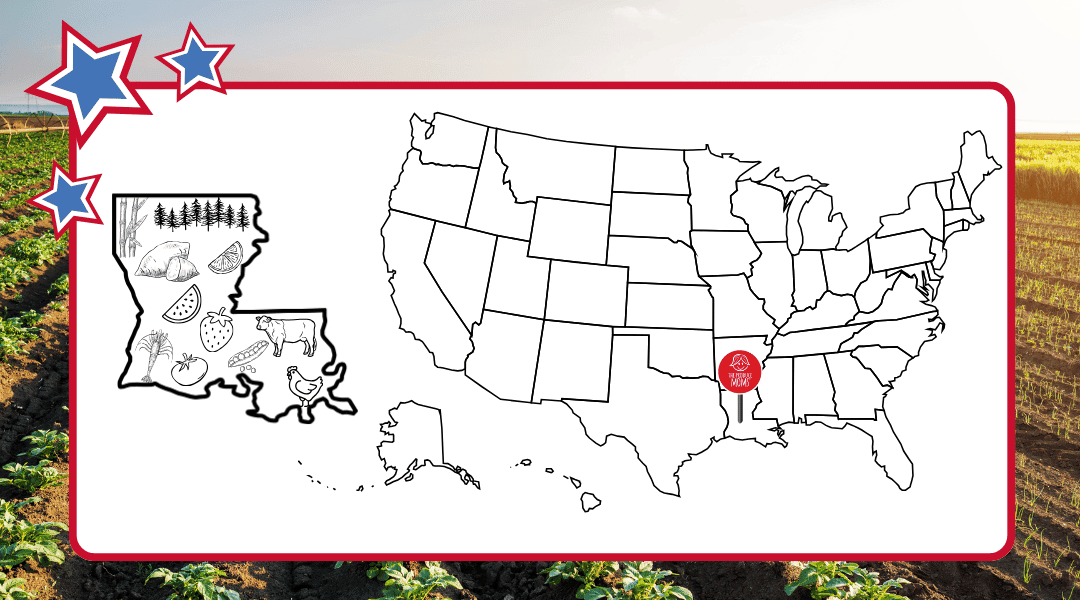
- Strawberries: Harvested from late winter through spring, strawberries are Louisiana’s official state fruit. Commercial production yields millions of dollars annually. It is also supported by local U-pick operations, roadside stands, and annual festivals that draw regional tourism.
- Satsumas & Citrus: Brought to southern Louisiana in the 1800s, satsuma mandarin oranges thrive in Plaquemines and neighboring coastal parishes. Recognized for their easy-to-peel skin and sweet flavor, satsumas anchor Louisiana’s citrus industry. It generates millions in annual sales alongside navel oranges and kumquats.
- Watermelons: Grown heavily in Washington, Union, and Bienville parishes, watermelons are a summertime staple across the state. Local research by the LSU AgCenter has helped growers optimize pest management and yield. This helps make watermelons one of the highest-volume fresh market fruits sold at local farm stands and grocery chains.
Top Vegetables
- Sweet Potatoes: Louisiana consistently ranks among the top national producers of sweet potatoes. It typically generates tens of millions of dollars in farm-gate value annually. It is also a supplier for processing plants across North America.
- Tomatoes: Designated as Louisiana’s official state vegetable, the tomato holds massive culinary and economic significance. Both commercial field growers and high-tunnel greenhouse operations supply fresh tomatoes to local restaurants and regional markets year-round.
- Southern Peas & Green Beans: Legumes like southern peas (black-eyed, purple hull, and crowder peas) and snap beans are widely cultivated across central and northern Louisiana parishes. Beyond supplying fresh vegetable markets, these crops naturally fix nitrogen in the soil, making them essential for sustainable crop rotations alongside corn and cotton.
Visit our Produce Directory and learn how to Select, Store and Serve these fruits & vegetables.
About 50 States of Agriculture
In celebration of 250 years of the United States, The Produce Moms is proud to present 50 States of Agriculture. This is an educational and free resource that celebrates the bounty of America. We utilized USDA and State Department of Agriculture data (Louisiana) for the content in this series.
Agriculture is the foundation of freedom. Food security is national security. This content series is a celebration of United States culture and the hard-working farmers who feed, fuel & clothe our nation and the world.
Visit another state from our 50 States of Agriculture.