South Carolina Agriculture

Nov 04, 2026

This post may contain affiliate links. Please read our disclosure policy.
South Carolina’s agricultural story is a rich narrative of transformation. It shifted from early reliance on labor-intensive cash crops to a modern, highly diversified industry. During the 18th and 19th centuries, the state’s agricultural economy was defined by “Carolina Gold” rice along the coast and cotton across the inland regions.
Prior to the Civil War, Georgetown County alone produced nearly half of all the rice in the United States. However, the fall of the plantation system following the Civil War, paired with environmental challenges like the devastating boll weevil infestation in the early 20th century, forced South Carolina farmers to adapt and move away from single-crop dependence.
Through the mid-20th century, South Carolina launched major agricultural diversification movements. Farmers moved into growing soybeans, corn, and peaches. They also started expanding poultry and livestock farming. Today, agribusiness stands as the state’s single largest industry sector. South Carolina is home to nearly 25,000 farms spanning almost 5 million acres of land.
Together with forestry, agribusiness contributes over $51 billion annually to the state’s economy and directly supports more than 250,000 jobs. In the modern era, South Carolina’s farming community balances long-standing traditions with forward-looking sustainability.
Initiatives like the “Certified South Carolina” campaign encourage consumers to support local farms. And modern operations rely heavily on precision agriculture, GPS-guided machinery, and smart water management. Today’s Palmetto State agriculture is a dynamic, resilient force. It connects historical roots to a high-tech future that keeps food on tables across the nation.
About the South Carolina Department of Agriculture
The core mission of the South Carolina Department of Agriculture (SCDA) is to promote and nurture the growth and development of the state’s agriculture sector and related businesses, while simultaneously assuring the safety and security of the buying public. Led by the state’s Commissioner of Agriculture, the agency acts as a vital bridge between local producers, commercial agribusinesses, and everyday consumers. They ensure there is a thriving and stable food economy in South Carolina.
To fulfill this mission, the department carries out a wide array of responsibilities. They include economic development,consumer protection, and marketing. A major arm of the SCDA focuses on consumer protection through rigorous food and feed safety inspections, managing standard weights and measures at retail counters, and testing fuel quality to prevent fraud. The agency also operates state farmers markets. And they spearhead promotional initiatives like the popular Certified South Carolina branding campaign. This helps consumers easily identify and buy local farm products.
Beyond regulatory duties and marketing, the department actively fosters industry expansion through economic development and grants. Programs such as the Agribusiness Center for Research and Entrepreneurship (ACRE) help fund agricultural innovation, support new startup ventures, and provide business workshops. By balancing public health oversight with active industry support, the SCDA works to ensure that farming remains a dominant economic engine for the Palmetto State.
Learn more at https://agriculture.sc.gov/.
Top 5 Agricultural Commodities in South Carolina
Agriculture serves as the economic backbone of South Carolina. The broader agribusiness sector contributes over $51 billion annually to the state’s economy. And it supports upwards of 250,000 local jobs. While the Palmetto State grows a remarkably diverse range of produce, a handful of key livestock and row crops generate the vast majority of agricultural revenue. Together, these primary commodities power regional supply chains, satisfy domestic demand across the United States, and showcase the strength of modern South Carolina farming.
Broilers
Broiler chickens are undisputed royalty in South Carolina’s farm economy, generating over $1.5 billion in annual cash receipts. Poultry operations stretch across the state and support thousands of farm families and processing facilities. South Carolina raises over 200 million broilers every year. South Carolina consistently ranks among the top broiler-producing states nationally. Millions of heads are shipped across the U.S. every week to supply national supermarket chains and restaurant networks.
Turkey & Poultry Products
Closely following broilers, turkey farming and chicken egg production combined represent a multi-hundred-million-dollar industry locally. South Carolina is home to major national poultry integrators, making poultry farming responsible for more than half of all agricultural livestock market value across the state. The state is a major contributor to America’s poultry supply, particularly during holiday seasons when South Carolina turkey processing operates at peak capacity to supply eastern U.S. markets.
Corn (Grain Corn)
Grain corn is a staple row crop across South Carolina’s inland agricultural counties. They cover roughly 300,000 acres every season. It generates well over $150 million annually in direct market receipts. And it serves as the foundational fuel for the state’s agriculture sector. Rather than being shipped away, a massive portion of South Carolina’s harvested corn remains right in the state. It goes straight to local feed mills to nourish the multi-billion-dollar poultry industry.
Soybeans
Soybeans span roughly 350,000 to 400,000 acres. They are one of South Carolina’s most widely planted crops. Soybeans play a vital dual role in local agriculture. They generate $100 million to $150 million in annual market value. And they serve as an essential rotational crop that naturally restores nitrogen to the soil after cotton or corn harvests. South Carolina soybeans feed directly into national crush plants and major Atlantic export terminals where they are shipped globally for animal feed, soybean oil, and industrial products.
Cotton & Cottonseed
Cotton remains a vital row crop for rural South Carolina communities, planting nearly 170,000 to 200,000 acres annually. Plus, cotton gins are critical economic hubs for local growers. The U.S. is a global leader in raw cotton exports, and South Carolina upland cotton is highly valued in national and international textile markets for its lint quality and fiber length. Beyond clothing, cottonseed extracted during the ginning process is a major national feed ingredient for dairy cattle and is processed into high-grade cooking oil.
Related: Cotton vs. Plastic: A Healthier Future Starts With Better Choices
Fruits and Vegetables from South Carolina
South Carolina’s favorable subtropical climate, diverse soil regions, and long growing seasons make it an ideal environment for specialty crop production. Beyond its massive row crops and poultry enterprises, the Palmetto State is renowned for cultivating a flavorful bounty of fresh fruits and vegetables. These specialty crops not only supply regional grocery chains, roadside stands, and local farmers markets, but they also anchor a multi-billion-dollar agricultural economy that pumps vitality into rural and coastal communities alike.
Top Fruits
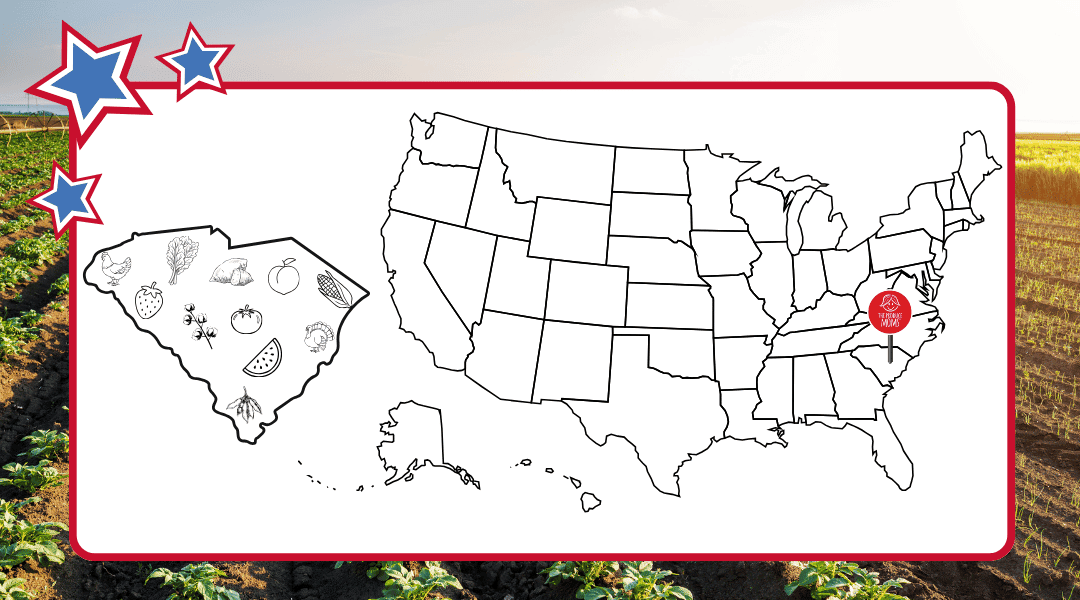
- Peaches: Peaches are the undisputed crown jewel of South Carolina’s fruit industry. Cultivated across roughly 15,000 to 18,000 acres, peach production generates tens of millions of dollars annually. South Carolina consistently ranks as the #2 peach-producing states in the nation (right behind California) and leads the entire South. In a typical year, the state harvests over 100 million to 200 million pounds.
- Watermelon: Watermelons are a powerhouse summer specialty crop. They generate substantial seasonal revenue for local growers and heavily supply regional packing and shipping networks. South Carolina dedicates thousands of acres to watermelon cultivation. It yields upwards of 1.3 million hundredweight (cwt) of fruit annually with an economic value approaching $18 to $20 million.
- Strawberries: Strawberries lead the state’s berries and small-fruit sector, kicking off South Carolina’s spring produce harvest. Grown on hundreds of acres across the state, South Carolina strawberries supply early-season fresh berries to regional markets along the East Coast before northern crops ripen.
Top Vegetables
- Greens: South Carolina is a national leader and cultural powerhouse when it comes to leafy greens. Collard, turnip, and mustard greens are heavily cultivated across the state. They supply commercial wholesalers, regional processors, and traditional southern food markets. The state frequently ranks #1 in the nation for overall collard green and turnip green production. Thousands of acres are dedicated to greens, providing a steady, year-round harvest due to the state’s mild winters.
- Tomatoes: Fresh-market tomatoes are one of South Carolina’s most valuable cash vegetable crops. During peak harvest seasons, the state supplies millions of pounds of fresh tomatoes to East Coast distribution hubs. South Carolina tomatoes benefit from a unique double-cropping window, allowing farmers to plant an early summer crop and a second fall crop before the first frost.
- Sweet Potatoes: Sweet potatoes are a cornerstone vegetable commodity. They offer reliable drought tolerance and strong market demand. The state ranks prominently in the southeastern U.S. for sweet potato acreage and production value, feeding into national retail markets, processing plants, and holiday food supply chains.
Visit our Produce Directory and learn how to Select, Store and Serve these fruits & vegetables.
About 50 States of Agriculture
In celebration of 250 years of the United States, The Produce Moms is proud to present 50 States of Agriculture. This is an educational and free resource that celebrates the bounty of America. We utilized USDA and State Department of Agriculture data (South Carolina) for the content in this series.
Agriculture is the foundation of freedom. Food security is national security. This content series is a celebration of United States culture and the hard-working farmers who feed, fuel & clothe our nation and the world.
Visit another state from our 50 States of Agriculture.