Virginia Agriculture

Nov 24, 2026

This post may contain affiliate links. Please read our disclosure policy.
Virginia’s agricultural story began long before European settlers arrived. It began with Indigenous communities cultivating the “Three Sisters” (corn, beans, and squash) using sustainable practices that kept the soil rich. That changed dramatically in the early 1600s. John Rolfe introduced a sweeter strain of tobacco at Jamestown. It sparked a cash-crop boom that reshaped the colony’s economy and landscape.
For over two centuries, tobacco was king. It drove the expansion of large plantations and entrenched the tragic system of enslaved labor. However, planting tobacco year after year quickly drained the earth of nutrients. It prompted an early soil-exhaustion crisis and pushed farmers westward into the Shenandoah Valley. There they established smaller, self-sufficient farms focused on wheat, corn, and livestock.
By the mid-19th and 20th centuries, Virginia agriculture underwent major transformations. It was driven by conflict, innovation, and changing markets. Following the devastation of the Civil War and the abolition of slavery, the plantation system broke apart into smaller farms, tenant farming, and sharecropping. Early soil-conservation pioneers encouraged the use of marl and crop rotation to heal depleted land.
In the 20th century, farmers steadily diversified away from single-crop dependency. This is in part due to railroad expansion, which brought mechanization, chemical fertilizers, and scientific advancements.
Today, agriculture remains Virginia’s largest private industry. It generates an estimated $82.3 billion in annual economic impact and supports roughly 381,800 jobs across the Commonwealth. Modern Virginia farming is remarkably diverse, spanning roughly 39,000 farms across 7.3 million acres. 95% of those farms are still owned by families or individuals rather than corporations.
Looking toward the future, Virginia’s agricultural landscape is increasingly defined by a blend of modern technology and a growing “buy local” movement. Everyday consumers are connecting more directly with growers through hundreds of farmers’ markets, farm-to-table restaurants, and thriving agritourism ventures. At the same time, farmers are adopting precision agriculture, regenerative soil practices, and indoor vertical farming to protect the Chesapeake Bay watershed and feed a growing population.
About the Virginia Department of Agriculture and Consumer Services
The Virginia Department of Agriculture and Consumer Services (VDACS) centers its mission on fostering the economic growth and development of Virginia’s agricultural sector, safeguarding consumers, and promoting environmental stewardship. Headquartered in Richmond, the agency operates across the Commonwealth through field offices, four regional animal health diagnostic laboratories, and international trade representatives, organizing its work around executive leadership and four core operational divisions covering animal and food industries, commodities, consumer protection, and marketing and development. They are led by an appointed Commissioner.
On the agricultural and economic side, VDACS supports farmers, agribusinesses, and forestry operations from production through sale. It provides grading and inspection services for commodities such as grains, fruits, vegetables, peanuts, poultry, and eggs, operates animal health and disease-control programs alongside laboratory diagnostics, and runs initiatives like Virginia Grown, Virginia’s Finest, and Farm-to-School to expand local, national, and export markets. The department also supports environmental care and land conservation through efforts such as farmland preservation, pesticide oversight, and agricultural stewardship programs.
In its consumer protection role, VDACS works to keep everyday transactions and products safe and fair across the state. Its teams inspect food and dairy operations to ensure products are wholesome and properly labeled, oversee weights and measures to verify accurate scales and pricing, and handle regulatory and complaint programs covering areas like charitable solicitations, charitable gaming, fantasy contests, and home service contracts.
Learn more at https://www.vdacs.virginia.gov/.
Top 5 Agricultural Commodities in Virginia
Agriculture is Virginia’s largest private industry. It generates an estimated $82.3 billion in annual economic impact and supports roughly 381,800 jobs across the Commonwealth. Virginia’s farming landscape is among the most diverse in the United States. According to USDA Economic Research Service data tracked by the Virginia Department of Agriculture and Consumer Services (VDACS), the state’s top five agricultural commodities by farm cash receipts account for the lion’s share of farm revenue and play vital roles both locally and across national supply chains.
Broilers
Broilers are Virginia’s undisputed #1 agricultural commodity. They generate nearly $1.25 billion in cash receipts each year. The sector drives billions in downstream economic activity, supporting local grain farmers who supply feed, processing plant workers, truckers, and family-owned contract growers. Virginia ranks 8th nationally in broiler production. It supplies hundreds of millions of birds each year to grocery stores and restaurants throughout the East Coast and across the country.
Cattle and Calves
Cattle grazing shapes the rolling pastures of the Shenandoah Valley, Piedmont, and Southwest Virginia, keeping hundreds of thousands of acres in open, productive green space. Raising cattle allows family farms on steeper, non-row-crop terrain to remain profitable while preventing soil erosion and preserving rural landscapes. Virginia serves as a major feeder-cattle state. Calves raised on Virginia’s nutrient-rich fescue pastures are routinely shipped to Midwestern feedlots to finish growing, playing an essential early-stage role in the U.S. beef supply chain.
Dairy Products
Dairy farms provide steady, year-round cash flow to rural communities. Virginia receives approximately $363 million each year from milk and dairy products. Virginia’s dairy herds supply fluid milk and processed dairy ingredients across the Mid-Atlantic and Southeast, helping stabilize regional milk supplies in fast-growing metropolitan areas. Virginia’s roughly 65,000 dairy cows produce nearly 1.4 billion pounds of milk annually
Soybeans
Soybeans are Virginia’s leading individual field crop. Locally, soybeans are critical both as a high-protein feed ingredient for Virginia’s massive poultry and livestock industries and as a nitrogen-fixing rotation crop that naturally enriches soil health. Beyond domestic food, livestock feed, and biodiesel production, soybeans are one of Virginia’s top agricultural exports, shipped through the Port of Virginia to global markets across Asia and Europe. Virginia farmers harvest roughly 590,000 acres of soybeans annually, yielding over 22 million bushels
Turkeys
Turkey farming sustains hundreds of family growers, feed mills, hatcheries, and major processing facilities across western Virginia. Virginia ranks 6th nationally in turkey production. They raise roughly 15.3 million turkeys annually to stock grocery freezers and deli counters across the United States.
Fruits and Vegetables from Virginia
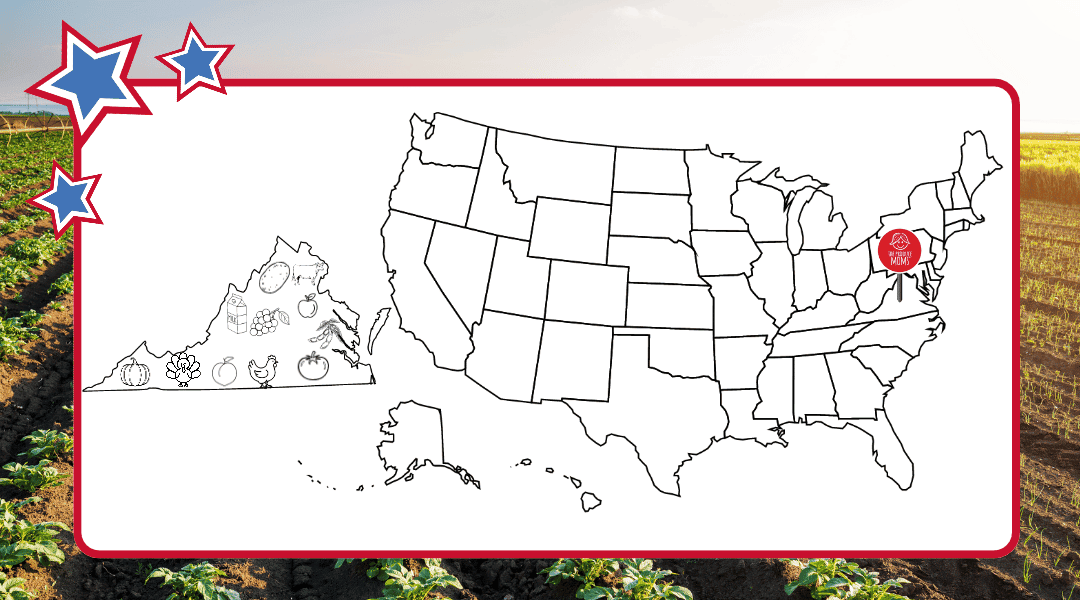
Specialty produce plays an outsized role in diversifying farm income, sustaining rural tourism, and stocking regional grocery aisles. According to USDA Census of Agriculture data, Virginia’s fruit, tree nut, and berry sector generates roughly $144 million in annual farm sales across more than 1,800 farms. Vegetables, melons, potatoes, and sweet potatoes contribute another $135 million. Because Virginia stretches from the sandy Coastal Plain to the cooler slopes of the Blue Ridge Mountains, growers can cultivate an impressive variety of high-value crops.
Top Fruits
- Apples: Apples are Virginia’s undisputed #1 fruit crop and its 13th largest agricultural commodity overall, generating roughly $64 million in annual farm cash receipts. Spanning roughly 11,150 acres. Virginia ranks 5th to 6th nationally in apple production.
- Wine Grapes: Grapes rank as Virginia’s second-largest fruit crop by acreage and economic footprint, covering roughly 4,300 to 5,000 acres across hundreds of commercial vineyards. They supply more than 300 Virginia wineries, supporting an industry that generates billions in broader economic activity
- Peaches: Peaches provide critical mid-summer cash flow for orchardists months before the autumn apple harvest begins. Because ripe peaches are delicate and ship best over shorter distances, they are a mainstay of Virginia’s farmers’ markets, roadside stands, and farm-to-table restaurants.
Top Vegetables
- Potatoes: Potatoes are Virginia’s largest vegetable crop by acreage, with roughly 3,900 to 4,000 acres harvested annually. Virginia’s potato harvest hits the market in early summer. They fill a crucial seasonal supply gap along the East Coast between southern winter crops and northern fall harvests.
- Tomatoes: Tomatoes are one of Virginia’s highest-value vegetable crops, cultivated both in open fields on the Eastern Shore and in high-tech, year-round indoor greenhouses across the state. Virginia plays a major role in supplying fresh-market round and Roma tomatoes to grocery chains up and down the Eastern Seaboard.
- Pumpkins: Pumpkins rank among Virginia’s top 20 agricultural commodities overall, generating nearly $14.7 million in annual cash receipts and placing Virginia 10th nationally in pumpkin production.
Visit our Produce Directory and learn how to Select, Store and Serve these fruits & vegetables.
About 50 States of Agriculture
In celebration of 250 years of the United States, The Produce Moms is proud to present 50 States of Agriculture. This is an educational and free resource that celebrates the bounty of America. We utilized USDA and State Department of Agriculture data (Virginia) for the content in this series.
Agriculture is the foundation of freedom. Food security is national security. This content series is a celebration of United States culture and the hard-working farmers who feed, fuel & clothe our nation and the world.
Visit another state from our 50 States of Agriculture.