Alaska Agriculture

Jun 24, 2026, Updated Jul 16, 2026

This post may contain affiliate links. Please read our disclosure policy.
When you think of Alaska, images of towering glaciers, roaming grizzlies, and snow-capped peaks probably come to mind long before tractor trailers and fields of grain. Historically, the Last Frontier has relied heavily on the Lower 48 states for its dinner table, traditionally importing over 80% to 95% of its food. This massive reliance on long supply chains means that a single shipping delay can leave grocery store shelves empty.However, out of necessity and a deep-rooted desire for self-reliance, Alaska’s agricultural landscape is undergoing a quiet, remarkable transformation.
Driven by recent global supply chain shakeups, Alaskans have put a major focus on local food security. The state’s farming community is unique because it is growing in a direction opposite to the rest of the country. While nationwide trends show family farms consolidating into giant commercial operations, Alaska is experiencing an influx of passionate, smaller-scale family farms—often under 50 acres. Interestingly, the state boasts one of the youngest average populations of farmers in America, alongside an exceptionally high percentage of female producers (nearly 50%), all working together to cultivate a more resilient food system closer to home.
Farming in the far north requires a blend of natural blessings and high-tech ingenuity. Alaska’s legendary summers offer up to 20 hours of daily sunlight, acting like a turbo-charger for crops. This intense sunlight allows standard vegetables to grow to staggering sizes. To stretch the state’s short growing window, modern Alaskan farmers heavily utilize “high tunnels” (hoop-house greenhouses) and indoor hydroponic systems. This means growing fresh greens in temperature-controlled environments even when the ground outside is frozen solid.
Beyond backyard greenhouses, Alaska’s agricultural footprint is expanding into vibrant niche markets. The state is proving that its agricultural future is as bright as its midnight sun.
About the State Department Natural Resources Division of Agriculture
The Alaska Division of Agriculture’s main purpose is to promote and encourage development of an agriculture industry in the State. It plays an important role in supporting the long-term health and sustainability of Alaskan agricultural resources.
Through collaboration with farmers, producers, landowners, and local communities, the division helps promote responsible land stewardship, conservation practices, and agricultural education. Its work focuses on balancing productive agriculture with the protection of natural resources. It ensures that future generations can continue to benefit from healthy soil, clean water, and thriving rural landscapes.
By providing guidance, resources, and programs that support both economic and environmental goals, the division helps strengthen agriculture while preserving the natural assets that communities depend on every day.
Learn more at https://dnr.alaska.gov/ag/
Top 5 Agricultural Commodities in Alaska
Due to its harsh winters and short growing season, Alaska’s top agricultural commodities rely on both cold-hardy crops and controlled environments. Depending on the reporting agency, Aquaculture is occasionally listed as the top overall commodity when considering commercial seafood harvests, though it is categorized separately from traditional farming.
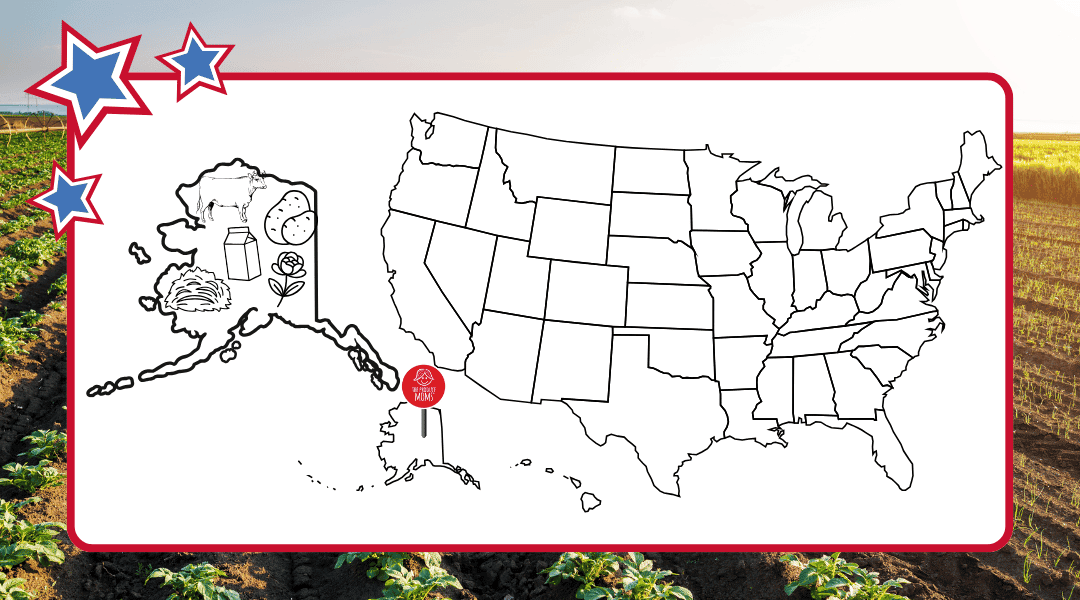
Greenhouse/Nursery
Nursery, greenhouse, floriculture, and sod crops account for $21.6 million in annual sales. These products play a vital role by providing locally grown plants, flowers, and landscaping materials despite the state’s challenging climate. These controlled growing environments help extend the growing season. As Alaska’s highest-value agricultural sector, greenhouse and nursery production contributes significantly to the state’s overall agricultural output and economic resilience.
Hay
Hay is mostly used to support livestock production throughout the state. However, it consistently ranks among Alaska’s most valuable farm products. Hay alone drives about 33% of Alaska’s total crop revenue. It is the single largest crop by acreage as it takes up nearly 40% of all Alaskan cropland.
Cattle and Calves
Cattle and calves play a vital role in localizing Alaska’s food supply. Despite facing immense structural challenges (i.e. intense wildlife predation, extreme winters that require indoor feeding for nine months of the year, and high shipping costs for feed) the beef and dairy sectors significantly anchor the state’s expanding $76 million animal agriculture economy. Additionally, grazing herds have historically been used to utilize and manage remote grassland ecosystems
Potatoes
Potatoes are Alaska’s most valuable cash crop. They thrive in the long summer daylight and cool soils of the Matanuska and Tanana Valleys. Because of the state’s geographic isolation, local potato fields are naturally shielded from many devastating pests and diseases found in the lower 48 states.
Dairy Products
Although Alaska’s dairy industry has shrunk to just a few commercial operations due to high feed and shipping costs, it remains highly valued for local food security. The state’s remaining dairy farms provide fresh, high-quality milk and cheese directly to local communities. While this represents less than 1% of the total fluid milk consumed by Alaskans, the sector holds outsized economic significance for local feed security.
Fruits & Vegetables from Alaska
Alaska has a resilient and rapidly evolving specialty fruit and vegetable industry. Thanks to its famous “Midnight Sun” (which provides up to 20 hours of continuous summer daylight) and nutrient-dense glacial soils, Alaska produces an array of fresh produce. The extended daylight supercharges photosynthesis, allowing local farmers to grow produce that is uniquely crisp, exceptionally sweet, and sometimes world-record-shattering in size.
Top Fruits
- Wild & Cultivated Berries: Extreme cold makes traditional tree fruit difficult, but blueberries, raspberries and strawberries and other berries thrive. Commercial growers and foragers harvest massive yields.
- Apples: They are the most successful and widely produced tree fruit in Alaska. Because regular apple trees cannot survive the brutal winters, Alaskan growers graft cold-tolerant scions onto extremely hardy Siberian crabapple rootstocks.
- Haskaps (Honeyberries): Often called the “blue honeysuckle,” Haskaps have exploded in popularity among Alaskan commercial fruit growers. These berry-producing bushes are native to northern climates and can easily survive negative temperatures. They taste like a flavorful cross between a blueberry and a raspberry and ripen much earlier than other local fruits.
While the state is famous for setting massive size records for produce like pumpkins and cantaloupes,, these are agricultural novelties rather than staple crops.
Top Vegetables
- Potatoes: The crown jewel of Alaska’s edible crop market. Thriving in the cool northern soils, Alaska’s disease-free potato industry serves as a crucial food-security crop and a top exporter of clean seed potatoes across North America.
- Cabbages & Cole Crops: Brassicas (cabbage, broccoli, kale) absolutely love Alaska’s cool summers. The continuous daylight allows standard varieties to grow incredibly sweet.
- Carrots & Root Crops: Root vegetables like carrots, turnips, and parsnips perform exceptionally well because cold nights force the plants to convert their starches into sugars to act as a natural antifreeze. Alaskan carrots are famous for being exceptionally sweet and crunchy!
Visit our Produce Directory and learn how to Select, Store and Serve these fruits & vegetables.
About 50 States of Agriculture
In celebration of 250 years of the United States, The Produce Moms is proud to present 50 States of Agriculture. This is an educational and free resource that celebrates the bounty of America. We utilized USDA and State Department of Agriculture data (Alaska) for the content in this series.
Agriculture is the foundation of freedom. Food security is national security. This content series is a celebration of United States culture and the hard-working farmers who feed, fuel & clothe our nation and the world.
Visit another state from our 50 States of Agriculture.