New York Agriculture

Oct 12, 2026

This post may contain affiliate links. Please read our disclosure policy.
Like many early states, agriculture in New York began with Indigenous peoples. They practiced the sustainable intercropping method known as the “Three Sisters”. By planting corn, beans, and squash together, they enriched the soil, maximized crop yields, and sustained thriving communities across the region.
European colonists later adapted these fields for European grains like wheat. They turned the Hudson Valley into a major breadbasket. And eventually built the Erie Canal in the 1820s. The engineering marvel opened trade routes to the Midwest. It also transformed New York City into a massive food market. And it allowed Upstate farmers to shift away from grain toward perishable, higher-value goods like fresh milk, apples, and specialty produce.
Today, New York boasts a powerhouse agricultural industry that generates over $8 billion in revenue annually across roughly 6.5 million acres of farmland. Dairy dominates the state’s agricultural output. It accounts for nearly half of all farm product sales. Plus, it makes New York the nation’s leading producer of yogurt, cottage cheese, and sour cream, as well as a top producer of fluid milk.
Modern New York agriculture continues to adapt through innovative movements that connect local farms with urban populations. Initiatives like the “Taste NY” program and a dense network of over 650 farmers’ markets push the farm-to-table philosophy directly into schools, restaurants, and grocery stores.
The state also leads the nation in certified organic farmland acreage. While high-tech urban farming initiatives (ranging from rooftop greenhouses in New York City to advanced indoor hydroponics upstate) ensure fresh produce reaches consumers year-round. 98% of New York farms are family-owned. Though total farm acreage has gradually consolidated over time, New York’s 30,000-plus farms continue to drive the state’s economic health and food security.
About the New York Department of Agriculture and Markets
The New York State Department of Agriculture and Markets (AGM) serves to foster a competitive, sustainable food and agricultural industry that protects consumers while supporting local producers. Its core mission centers on promoting New York’s diverse agricultural products, advancing environmental stewardship of farmland, protecting animal health, and maintaining food safety and market equity across the state. By connecting regional farms directly to local communities and retail institutions, the department works to secure the state’s food supply and build a resilient agricultural economy.
To fulfill this mission, AGM oversees a wide range of regulatory and promotional responsibilities. They are lead by a nominated Commissioner. The agency monitors food safety from production to retail through routine inspections and laboratory testing, enforces accurate trade standards for commercial scales and gas pumps, and inspects companion animal shelters. It also manages state programs like Taste NY and NYS Grown & Certified, which promote New York-grown commodities, help farmers adopt climate-friendly practices, and fund infrastructure projects that bring local produce into schools and emergency food networks.
The agency’s operational structure developed through several pivotal legislative milestones:
- February 27, 1922: The state enacted the Farms and Markets Law, consolidating disparate agricultural commissions into a cohesive department.
- April 29, 1926: New York formally established the Department of Agriculture and Markets under its current name as part of a broader state government reorganization.
- April 23, 1940: The state created the Soil and Water Conservation Committee within AGM to oversee soil preservation and natural resource protection on farmland.
- 2016: AGM launched the New York State Grown & Certified program to help consumers easily identify food grown locally under high environmental and food safety standards.
Learn more at https://agriculture.ny.gov/.
Top 5 Agricultural Commodities in New York
Beyond its famous skyline and urban centers, New York holds a commanding position as a national agricultural giant. It is driven by fertile soils, abundant rainfall, and diverse microclimates. The Empire State produces an extraordinary variety of food and fiber. Farming accounts for billions of dollars in annual revenue. It also sustains tens of thousands of local jobs while supplying crucial commodities to regional and international markets. Five major agricultural commodities stand out as the primary powerhouses driving both the local economy and the national food supply.
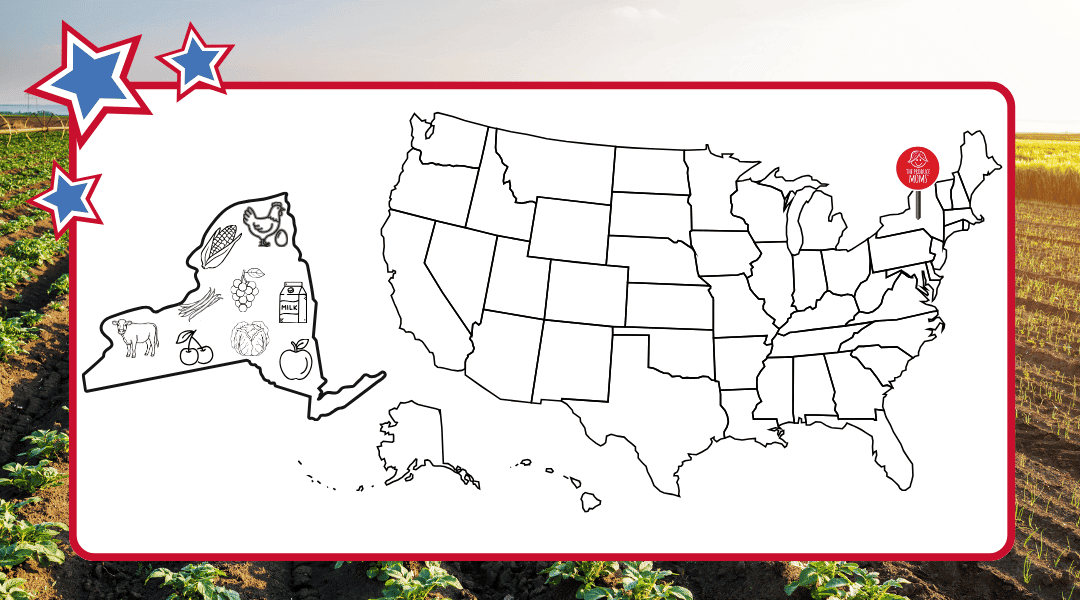
Fluid Milk & Dairy Products
Dairy stands as the undisputed king of New York agriculture. It generates nearly $3.9 billion annually and accounts for almost half of the state’s total agricultural sales. Local dairy farms keep processing plants running across Upstate New York. It helps with revitalizing rural economies and providing fresh milk to major metropolitan centers along the East Coast. Nationally, New York ranks fifth in total fluid milk production. However, it dominates specialized dairy processing. It holds the number-one national ranking for yogurt, cottage cheese, sour cream, and total Italian cheeses.
Corn
Locally, corn acts as the foundational feed supply for New York’s 600,000-plus dairy cows. Dairy farmers utilize roughly half of the state’s corn acreage specifically for corn silage. This means they are harvesting the entire green plant, stalk, cob, and leaves, and fermenting it to create a nutrient-rich, high-energy feed. Beyond livestock feed, local vegetable growers plant thousands of acres of fresh-market sweet corn, supplying farm stands, grocery chains, and seasonal urban markets throughout the summer. The remaining field corn acres generate grain for livestock feed mixtures and feed regional bio-energy producers.
Cattle and Calves
Cattles and calves are both the foundation for beef production and as an essential, high-value byproduct of the state’s massive dairy industry. Locally, cattle operations generate nearly $500 million in annual cash receipts. Nationally, New York acts as a vital eastern hub for cattle inventory.
Apples
Apples represent New York’s signature fruit crop. It covers over 50,000 acres of orchards across the Hudson Valley, Lake Ontario region, and Champlain Valley. The crop generates hundreds of millions of dollars in cash receipts. It also powers a robust agritourism industry through fall u-pick orchards and cider mills. On the national stage, New York consistently holds the number-two spot behind Washington state. New York harvests roughly 1.3 to 1.5 billion pounds of apples each year for both fresh market eating and processing into juice, sauce, and hard cider.
Related: Types of Apples From Sweet to Tart
Poultry & Eggs
Poultry and egg production provides a vital stream of revenue and localized food security across New York. It generates well over $400 million in annual cash receipts. Locally, egg layers and poultry operations anchor diversified family farms by delivering fresh eggs and poultry products directly to major metropolitan markets and neighborhood grocery stores. Chicken egg production serves as the financial centerpiece of this sector. And turkey farming and broiler production supply critical regional processing plants and seasonal holiday markets.
Fruits and Vegetables from New York
New York generates roughly $1.2 billion annually in combined fruit and vegetable sales. While many people associate the Empire State strictly with its dense urban centers, its rural regions fuel a massive specialty crop sector. It feeds both the East Coast and the broader nation. Together, fruit and vegetable production supports thousands of local farm families. Plus it anchors regional food processing industries and anchors New York’s national footprint in specialty agriculture.
Top Fruits
- Apples: Apples serve as New York’s flagship fruit crop. It brings in hundreds of millions of dollars each year. They harvest roughly 1.3 to 1.5 billion pounds annually across 50,000-plus acres. New York consistently ranks 2nd in the nation behind Washington state.
- Grapes: Spanning more than 30,000 acres, grape production places New York 2nd or 3rd nationally. They compete closely with Washington state, just behind California. Beyond direct farm receipts, grape production powers a multi-billion-dollar craft beverage and winery tourism economy.
- Tart Cherries: While sweet cherries are grown in smaller quantities for local markets, tart cherries represent New York’s third most commercially significant fruit crop. New York is in the top 4 states nationwide for tart cherry production
Top Vegetables
- Cabbage: Cabbage stands as New York’s most profitable vegetable crop. It regularly competes with California and Texas for the #1 or #2 spots nationwide in total fresh and processing cabbage production. Farmers harvest over 12,000 acres annually.
- Snap Beans (Green Beans): New York is an elite producer of fresh market and processing snap beans. It ranks in the top 2 states nationally alongside Wisconsin. Thousands of acres yield millions of pounds of beans each summer. They are destined for both fresh grocery produce aisles and regional canning or freezing facilities.
- Sweet Corn: Sweet corn is a seasonal powerhouse in New York. It is in the top 5 to top 10 producers nationally for fresh market sweet corn. It is grown in virtually every agricultural county. Farmers plant tens of thousands of acres to supply farm stands, farmers’ markets, and supermarket chains throughout late summer.
Visit our Produce Directory and learn how to Select, Store and Serve these fruits & vegetables.
About 50 States of Agriculture
In celebration of 250 years of the United States, The Produce Moms is proud to present 50 States of Agriculture. This is an educational and free resource that celebrates the bounty of America. We utilized USDA and State Department of Agriculture data (New York) for the content in this series.
Agriculture is the foundation of freedom. Food security is national security. This content series is a celebration of United States culture and the hard-working farmers who feed, fuel & clothe our nation and the world.
Visit another state from our 50 States of Agriculture.