Minnesota Agriculture

Sep 03, 2026

This post may contain affiliate links. Please read our disclosure policy.
The fertile prairies and vast waterways laid the groundwork for Minnesota to be an agricultural superpower. In the mid-to-late 1800s, early European settlers were drawn by the Homestead Act to establish small, family-run farms. Early agriculture focused heavily on spring wheat, transforming the region into the breadbasket of the nation.
Powered by the mighty Mississippi River, Minneapolis earned the nickname “Mill City,” becoming the flour-milling capital of the world, thanks to iconic companies like Pillsbury and General Mills. However, relying on a single crop proved risky due to soil depletion and pest outbreaks. This prompted a major shift toward crop diversification. During this time corn, soybeans, and livestock were introduced into the mix.
The 20th century brought rapid innovation and structural transformation to Minnesota’s countryside. As farm equipment shifted from horse-drawn plows to steam engines and gas tractors, farmers could manage significantly more land with less manual labor.
The mid-1900s saw the rise of the cooperative movement. This is where local farmers joined forces to form buyer and producer co-ops. This allowed them to pool resources, stabilize prices, and build ethanol plants. Meanwhile, researchers at the University of Minnesota pioneered crucial agricultural breakthroughs. They range from breeding cold-hardy crops to developing the world-famous Honeycrisp apple, proving that local science could reshape national consumer habits.
Today, agriculture remains one of the primary engines driving Minnesota’s economy. The state is home to over 65,000 farms that cover roughly 25 million acres. It generates tens of billions of dollars in agricultural sales annually. Modern Minnesota farming bridges a rich tradition with cutting-edge technology. It uses GPS-guided tractors, precision soil management, and renewable energy production, like biodiesel and ethanol, to feed the world while preserving the land for the next generation.
About the Minnesota Department of Agriculture
The Minnesota Department of Agriculture (MDA) serves as the executive agency overseeing the state’s multi-billion-dollar agricultural sector. The department’s core mission is “to enhance all Minnesotans’ quality of life by equitably ensuring the integrity of our food supply, the health of our environment, and the strength and resilience of our agricultural economy.” It is overseen by an appointed Commissioner.
Rather than acting purely as a regulatory body, the MDA works directly alongside growers, food producers, and local communities to bridge the gap between farm fields and dinner tables.
At its core, the MDA’s work is divided into three key areas of responsibility: protecting the food supply, safeguarding natural resources, and cultivating the agricultural economy. To ensure consumer safety, inspectors monitor the entire supply chain. This ranges from seed purity and fertilizer registration on the farm, to sanitation standards at dairy plants, meat processors, and local grocery stores.
Simultaneously, the department plays a major role in environmental stewardship by managing pesticide safety, monitoring groundwater quality, and controlling invasive species like the emerald ash borer.
Beyond safety and regulation, the MDA actively drives economic growth for Minnesota’s 65,000+ farms. Through financial initiatives like the Agricultural Growth, Research, and Innovation (AGRI) program and Rural Finance Authority loans, the department offers crucial grants for beginning farmers, soil health practices, and local food processing infrastructure.
It also connects everyday consumers directly with local producers through popular programs like Minnesota Grown, supports the expanding organic sector, and opens international trade doors for Minnesota-grown crops and livestock worldwide.
Learn more at https://www.mda.state.mn.us/.
Top 5 Agricultural Commodities in Minnesota
Minnesota ranks as one of the top overall agricultural producers in the United States. It generates tens of billions of dollars in economic value each year. Thanks to a rich landscape of fertile prairie soils, abundant water resources, and a long tradition of farming innovation, the North Star State produces a diverse mix of row crops and livestock. Agriculture serves as a primary pillar of Minnesota’s economy. It supports over 300,000 local jobs. Simultaneously, it acts as a global powerhouse that exports food, feed, and fuel across the globe.
Corn (Field Corn)
Field corn is Minnesota’s largest crop by acreage and total production value. Locally, it fuels the state’s livestock industry and powers 19 ethanol processing plants. It helps make Minnesota a national leader in renewable bioenergy. Nationally, Minnesota consistently ranks among the top 4 corn-producing states, shipping massive quantities down the Mississippi River to support global food systems and industrial supply chains. Minnesota farmers routinely harvest over 1.4 billion bushels of corn per year. While most people think of corn on the cob, less than 1% of the corn grown in Minnesota is for eating. The majority is field corn destined for animal feed, biofuel, and starch.
Soybeans
Soybeans run neck-and-neck with corn for cropland footprint in Minnesota. Soy acts as the state’s single largest agricultural export commodity. It drives deep international trade ties with partners like China, Mexico, and Canada. Processing facilities across the state crush soybeans into meal for animal feed and oil for cooking and biodiesel, powering both rural and port economies.
Hogs (Pork)
Hogs are Minnesota’s top livestock commodity. It anchors the agricultural economy of Southern and Central Minnesota. At any given time, Minnesota is home to over 9 million hogs. The swine industry supports thousands of processing, packaging, and shipping jobs statewide. Nationally, Minnesota ranks #2 in pork production (behind only Iowa). It supplies high-quality pork products across North America and to major overseas markets like Japan and Mexico.
Dairy Products & Milk
Minnesota’s dairy sector forms the backbone of many rural communities. It supports farm families, regional creameries, and processing plants that produce milk, butter, and artisan cheeses. The average Minnesota dairy cow produces over 24,000 lbs (nearly 2,800 gallons) of milk every year. Minnesota ranks in the top 10 states nationally for milk production, Minnesota’s dairy industry contributes billions of dollars annually to the regional economy and fuels well-known national brands.
Sugar Beets
Grown predominantly in the rich soils of the Red River Valley in northwestern Minnesota, sugar beets are a massive specialty crop driver. Sugar beets thrive in Minnesota’s cold Northern soils. Minnesota is the #1 sugar beet producer in the United States. It accounts for roughly one-third of the nation’s total output. Grower-owned cooperatives process these beets locally, supplying refined white sugar to food manufacturers across the nation.
While these five represent the top overall revenue drivers, Minnesota also holds the #1 national spot for turkey production and sweet corn for processing!
Fruits and Vegetables from Minnesota
While Minnesota is famously celebrated for its vast commodity grain fields of corn and soybeans, the state is also a major national producer of high-value fruits and specialty vegetables. Cold-climate agricultural research, pioneered largely by the University of Minnesota, has allowed northern growers to cultivate hearty, sweet, and cold-resistant crops that thrive during the state’s warm summers. From commercial processing of vegetables that stock grocery shelves nationwide to beloved fruit orchards and local agritourism, Minnesota’s produce sector plays a vital role in balancing the state’s agricultural economy.
Top Fruits
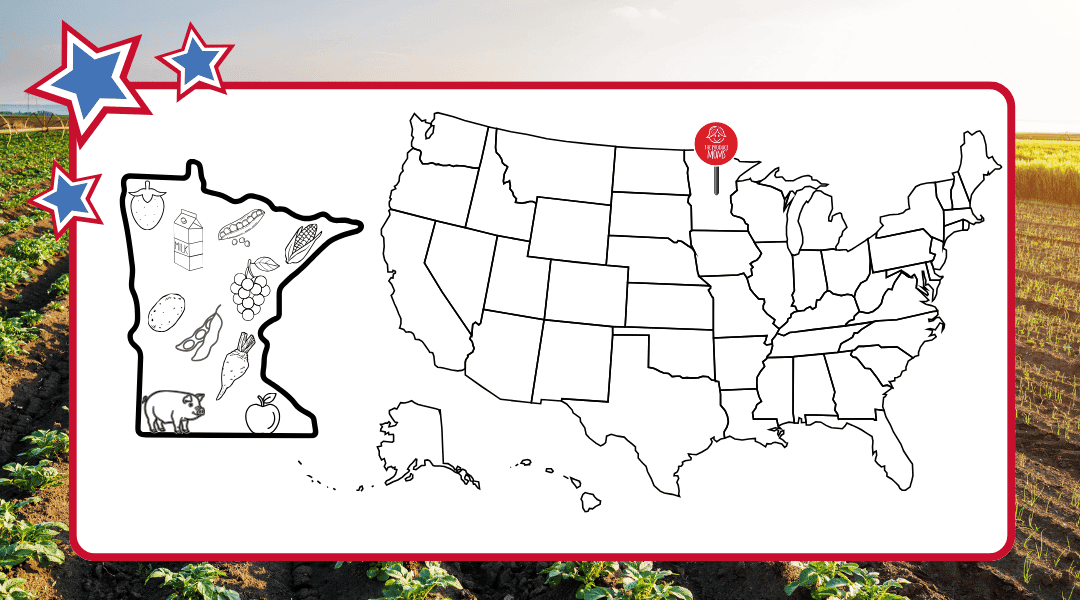
- Apples: Apples are Minnesota’s primary tree-fruit crop. They generate tens of millions of dollars annually across roughly 700 commercial orchards. The state is internationally famous for apple breeding. The University of Minnesota developed the world-renowned Honeycrisp which was designated Minnesota’s official state fruit in 2006.
- Strawberries: Strawberries lead Minnesota’s small-fruit production. They offer local growers high early-season revenue before larger fall crops mature. Thanks to cold-hardy breeding programs and the adoption of low-tunnel growing systems, Minnesota farmers produce both traditional June-bearing and day-neutral varieties that bear fruit well into the autumn.
- Grapes (Cold Hardy Wine Grapes): Over the last three decades, Minnesota’s fruit landscape has been transformed by the development of cold-hardy wine grapes. Special varieties can survive brutal winter temperatures dipping down to -30°F without freezing the vine roots. This horticultural breakthrough launched Minnesota’s thriving farm-winery industry, supporting dozens of craft wineries and regional tourism.
Top Vegetables
- Sweet Corn (Processing & Fresh): Minnesota is a national titan in vegetable production. It consistently ranks #2 in the United States for sweet corn grown for processing (canning and freezing). It is grown primarily across the fertile soils of southern and central Minnesota. The sweet corn feeds both national consumer packaged goods brands and local summer farm stands. Minnesota farmers harvest roughly 100,000 acres of sweet corn every year. It produces hundreds of thousands of tons to supply major food processors across North America.
- Green Peas (Processing): Running right alongside sweet corn, Minnesota ranks #2 nationwide for green peas produced for processing. Because green peas thrive in cooler spring soils and require a short growing season, they fit seamlessly into crop rotations with field corn and soybeans. It helps maximize farmland efficiency for Minnesota growers.
- Potatoes: Potatoes are one of Minnesota’s most lucrative specialty crops. It is grown heavily in the irrigated sandy soils of the Central Sands region and the Red River Valley. Minnesota ranks among the top 10 potato-producing states in the country. Minnesota grows over 45,000 acres of potatoes annually. It supplies massive volumes for fresh table use, chip manufacturing, and frozen potato products like french fries.
Visit our Produce Directory and learn how to Select, Store and Serve these fruits & vegetables.
About 50 States of Agriculture
In celebration of 250 years of the United States, The Produce Moms is proud to present 50 States of Agriculture. This is an educational and free resource that celebrates the bounty of America. We utilized USDA and State Department of Agriculture data (Minnesota) for the content in this series.
Agriculture is the foundation of freedom. Food security is national security. This content series is a celebration of United States culture and the hard-working farmers who feed, fuel & clothe our nation and the world.
Visit another state from our 50 States of Agriculture.