North Carolina Agriculture

Oct 14, 2026

This post may contain affiliate links. Please read our disclosure policy.
North Carolina’s agricultural story begins centuries ago. It started with small family farms and native crops like corn, beans, and squash. During the 18th and 19th centuries, the state’s mild climate and fertile soils turned it into an agrarian powerhouse.
Tobacco became the undisputed king of North Carolina agriculture for generations. It drove local economies and defined the rural landscape. Alongside tobacco, farmers across the Coastal Plain and Piedmont regions cultivated cotton, peanuts, and sweet potatoes. North Carolina was quickly established as a state that was a vital food and fiber provider for the nation.
Over the past few decades, Tar Heel agriculture underwent a dramatic evolution. Today, North Carolina has successfully transformed into one of the most diversified and technologically advanced agricultural states in the country. Agriculture and agribusiness stand as the state’s top industry. It contributes over $100 billion annually to the local economy. It also employs roughly one-sixth of North Carolina’s workforce.
Modern North Carolina farming seamlessly blends deep-rooted tradition with cutting-edge innovation. Farmers across the state now embrace sustainable practices, automated harvesting, and precision agriculture technology. Today, more than 42,000 farms span over 8 million acres across North Carolina. From thriving local farmers’ markets and organic produce operations to world-renowned research at state universities, North Carolina continues to nourish millions of families across the country while driving modern sustainable farming forward.
About the North Carolina Department of Agriculture and Consumer Services
The North Carolina Department of Agriculture and Consumer Services (NCDA&CS) operates with the core mission to provide services that promote, protect, and enhance the state’s agriculture, environment, and economy. Led by the state’s Commissioner of Agriculture, the department serves as a vital pillar for residents, farmers, and agribusinesses alike.
Its overarching goal is to ensure that North Carolina maintains a robust, sustainable, and productive agricultural sector while safeguarding the public through comprehensive consumer-focused services.
To fulfill this mission, the organization manages a diverse array of divisions and responsibilities that touch nearly every aspect of daily life in the state. Key duties include enforcing rigorous food safety and drug protection standards, testing soil and agronomic samples to optimize crop yields, and inspecting agricultural scales and gas pumps to protect everyday consumers.
Additionally, the department oversees programs for forest management, soil and water conservation, veterinary health, and pest control, while also hosting popular community traditions like the annual N.C. State Fair.
Learn more at https://www.ncagr.gov/.
Top 5 Agricultural Commodities in North Carolina
North Carolina boasts a rich, highly diverse agricultural landscape. It reaches far beyond its borders. Ranking as the state’s top industry, agriculture and agribusiness pump over $100 billion into the local economy while supporting hundreds of thousands of jobs. Across the state’s varied climate and fertile soils, farmers cultivate a massive variety of crops and livestock. North Carolina is established as an indispensable powerhouse in the American food supply chain.
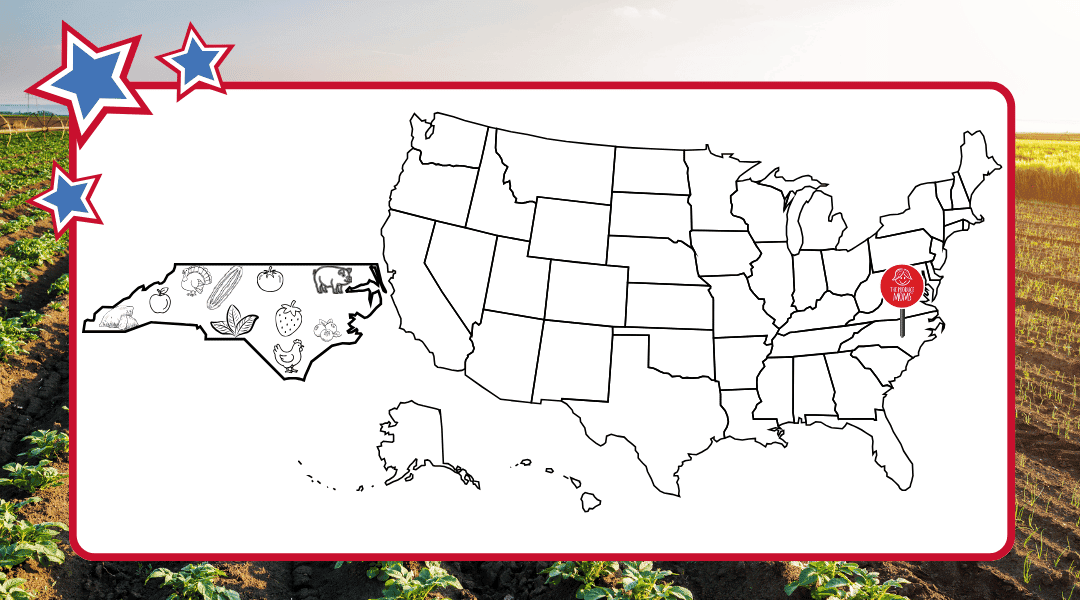
Broilers (Chickens)
Poultry production stands as a massive economic driver for North Carolina, with broilers reigning supreme among livestock commodities. North Carolina consistently ranks among the top states in the nation for broiler production. It generates billions of dollars in cash receipts annually. This sector supports an extensive network of contract family farms, feed mills, processing plants, and transportation logistics.
Sweet Potatoes
North Carolina dominates the American sweet potato industry. It grows and produces over half of all sweet potatoes grown in the United States. The state’s warm climate and sandy Coastal Plain soils create the ideal environment for growing this nutrient-dense crop. North Carolina farmers produce roughly 54% to 60% of the entire U.S. sweet potato supply annually. Because of this massive yield, the sweet potato was officially designated as the State Vegetable of North Carolina in 1995.
Hogs & Pigs
Hog farming represents another cornerstone of North Carolina’s agricultural identity. It is deeply rooted in the state’s rural economy. North Carolina ranks among the top three states nationwide for pork production. The state’s swine industry generates billions of dollars in economic activity. It supports feed producers, veterinarians, processing facilities, and local businesses. The state’s pork sector is renowned for its efficiency and biosecurity measures.
Turkeys
Alongside broiler chickens, turkeys play a massive role in cementing North Carolina’s poultry prestige. It consistently holds a top-three ranking nationwide for turkey production. The industry provides a steady, reliable market for local grain farmers who supply massive amounts of corn and soybeans for feed. North Carolina farmers raise millions of turkeys each year. This means that a significant percentage of the holiday turkeys served on dinner tables across America during Thanksgiving originate from the Tar Heel State.
Tobacco
As one of the most historically significant crops in American history, tobacco remains a major player in North Carolina’s agricultural portfolio. North Carolina ranks as the #1 producer of tobacco in the United States. For generations, tobacco defined the rural economy, funding schools, infrastructure, and communities throughout the Piedmont and Coastal regions. It still commands substantial acreage and export value, preserving a deep historical link to the state’s agrarian past.
Fruits and Vegetables from North Carolina
North Carolina’s geography creates a unique set of microclimates and soil profiles ideal for produce cultivation. Agriculture serves as the economic backbone of the state. While row crops like corn and soybeans cover substantial acreage, the state’s high-value fruit and vegetable crops play a vital role in diversifying farm income, supporting seasonal employment, and supplying fresh, nutrient-dense produce to markets across the United States.
Top Fruits
- Blueberries: Blueberries represent North Carolina’s most economically valuable fruit crop. It has an annual production value frequently exceeding $80 million to $100 million. North Carolina consistently ranks among the top seven states nationally for cultivated blueberry production.
- Apples: Apple orchards are a cornerstone of the mountain economy in western North Carolina. Tar Heel orchards produce up to 4 million bushels of apples annually. North Carolina ranks among the top ten apple-producing states in the country.
- Strawberries: Strawberries are a major specialty crop for North Carolina. It is ranked top three nationwide for strawberry production. Grown using plasticulture techniques across hundreds of small family farms, they are a primary driver for local direct-to-consumer sales.
Top Vegetables
- Sweet Potatoes: North Carolina ranks #1 in the nation. It produces nearly 60% of the total U.S. sweet potato supply with an annual production value often topping $300 million to $350 million.
- Cucumbers: Cucumbers are a vital vegetable crop for the Coastal Plain region. Farmers grow varieties for both the fresh market and the pickling industry. North Carolina consistently ranks among the top states nationally for pickle cucumber production.
- Tomatoes: Fresh-market tomatoes are a major contributor to North Carolina’s horticultural economy, particularly vine-ripened varieties cultivated in the western mountain valleys and central Piedmont.
Visit our Produce Directory and learn how to Select, Store and Serve these fruits & vegetables.
About 50 States of Agriculture
In celebration of 250 years of the United States, The Produce Moms is proud to present 50 States of Agriculture. This is an educational and free resource that celebrates the bounty of America. We utilized USDA and State Department of Agriculture data (North Carolina) for the content in this series.
Agriculture is the foundation of freedom. Food security is national security. This content series is a celebration of United States culture and the hard-working farmers who feed, fuel & clothe our nation and the world.
Visit another state from our 50 States of Agriculture.