New Hampshire Agriculture

Oct 01, 2026

This post may contain affiliate links. Please read our disclosure policy.
In the beginning, Indigenous communities cultivated corn, beans, and squash along rich river valleys. These are known as the famous “Three Sisters,” When 18th-century European homesteaders cleared the dense, rocky timberland, they established small family farms for self-sufficiency. And in 1719, they planted North America’s very first potato crop in Londonderry.
Agriculture reached its peak in the mid-1800s. This is when sheep farming swept through the hillsides to feed the region’s booming textile mills. However, as the Industrial Revolution drew young workers toward factory cities and the fertile, rock-free soil of the American West opened up, many Granite State farmers abandoned their fields. This allowed native forests to reclaim much of the cleared land.
Today, New Hampshire agriculture thrives by prioritizing quality, local connection, and direct-to-consumer sales over massive industrial crop yields. The state holds nearly 4,000 farms spanning over 417,000 acres. They generate around $249 million in direct agricultural sales each year.
Because the state’s rocky soil limits traditional row-crop farming, local producers focus heavily on high-value products. Modern Granite State farmers actively embrace vibrant agricultural movements that directly support local communities. Agritourism draws millions of visitors every year and serves as a primary driver of farm income.
Additionally, farmers markets, community-supported agriculture (CSA) programs, and local farm stands connect residents straight to fresh food, keeping family farms economically viable. By combining centuries of resilience with modern sustainability, New Hampshire turns its modest farm footprint into a vital piece of the state’s culture and everyday diet. Notably, women play a major role in powering this modern movement, representing 45% of all farm producers in the state.
About the New Hampshire Department of Agriculture, Markets, and Food
The New Hampshire Department of Agriculture, Markets, and Food (NHDAMF) leads the state’s efforts to support local farmers, foster a vibrant food economy, and protect public health. The department operates under a core mission to promote agriculture and serve both consumers and businesses to benefit the state’s economy, environment, and overall well-being. By enhancing the quality of life for Granite State residents, the agency focuses on building a resilient local food system. Through technical assistance, grant funding, and market development programs like the Weekly Market Bulletin, the department actively helps farmers expand their businesses, adopt sustainable practices, and connect directly with local consumers.
To fulfill its mission, the department organizes its work across six specialized divisions:
- Agricultural Development
- Animal Industry
- Pesticide Control
- Plant Industry
- Regulatory Services
- Weights and Measures.
Operating under the leadership of the Commissioner’s office, these divisions oversee essential services that ensure food safety, monitor animal and plant health, and maintain fair commercial standards statewide. Whether regulating pesticides, managing animal population programs, inspecting food processing standards, or enforcing accurate commercial measurements, the department balances proactive business promotion with strict regulatory oversight to keep New Hampshire’s agricultural sector strong and trustworthy.
Learn more at https://www.agriculture.nh.gov/.
Top 5 Agricultural Commodities in New Hampshire
New Hampshire’s agricultural identity reflects adaptiveness, resilience, and a deep-rooted connection to local consumers. While there is limited industrial crop production, nearly 3,850 farms make powerful economic and cultural contributions across its 420,000 farm acres. By concentrating on high-value crops, greenhouse production, and specialty livestock goods, local agricultural producers supply fresh regional markets, support vibrant tourism, and preserve open spaces.
Greenhouse and Nursery Products
Greenhouse plants, bedding flowers, ornamental shrubs, and Christmas trees generate the highest agricultural crop sales in New Hampshire. Controlled-environment agriculture allows local growers to extend short North East growing seasons and serve regional landscaping markets. New Hampshire farms harvest tens of thousands of Christmas trees annually, shipping balsam firs throughout the East Coast.
Dairy Products
Dairy operations anchor New Hampshire’s traditional livestock sector. Family-owned dairy farms manage herds of Holstein and Jersey cows to yield fresh fluid milk, specialty artisanal cheeses, yogurt, and ice cream. Dairy production accounts for a substantial share of total farm income, preserving scenic open pastures and supplying local schools and grocery stores.
Apples
Apples serve as a centerpiece of Granite State agriculture. New Hampshire orchards supply commercial fruit distributors and cider makers throughout the Northeast. Pick-your-own orchards form the backbone of fall agritourism, driving seasonal revenue for farm stands, bakeries, and cider mills.
Hay and Forage Crops
Farmers cultivate hay and haylage across tens of thousands of harvest acres to support regional livestock operations. Harvested fields yield over 60,000 tons of hay annually, valued at over $11 million. Locally grown alfalfa and mixed grass hay supply essential winter feed for dairy cattle, beef herds, horses, sheep, and goats.
Maple Syrup
Maple sugaring represents one of New Hampshire’s most cherished cultural traditions. Sugar makers tap native sugar maple trees every late winter and early spring to collect clear sap and boil it down into pure golden syrup. New Hampshire generates roughly 4% of total U.S. maple syrup production, yielding over 150,000 gallons each year.
Fruits and Vegetables from New Hampshire
New Hampshire’s cool climate, rocky terrain, and short growing season shape a distinct specialty crop sector focused on direct-to-consumer sales. Rather than cultivating vast, single-crop industrial fields, Granite State growers focus on high-value fruit orchards and fresh market produce. Specialty crops generate tens of millions of dollars for the state economy each year, anchoring community farmers markets, road-side stands, and thriving pick-your-own agritourism operations that connect residents directly to their food supply.
Top Fruits
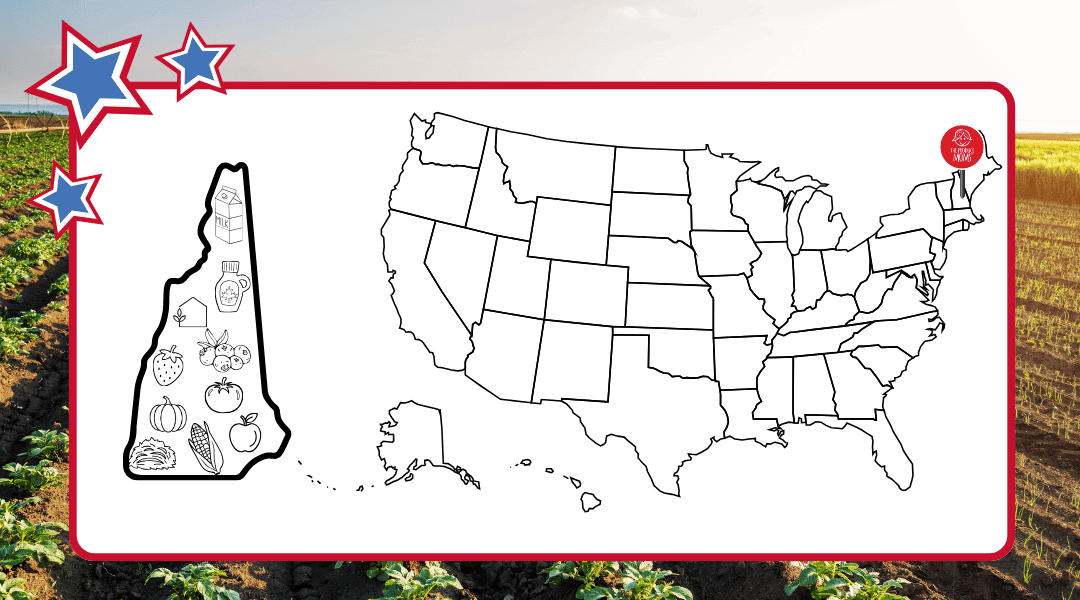
- Apples: Apples dominate the state’s commercial fruit output. It generates around $10 million to $15 million annually across more than 3,000 bearing acres. Beyond direct fruit sales, orchards form the heart of fall agritourism. Cider production, fresh bakery sales, and pick-your-own weekend trips bring hundreds of thousands of visitors to rural communities every September and October.
- Blueberries (highbush and lowbush): Both cultivated highbush blueberries and wild lowbush varieties cover hundreds of acres in New Hampshire. They produce a crop valued at over $2 million each summer.
- Strawberries: As the earliest commercial fruit crop to ripen in New England, strawberries bring in roughly $1 million to $1.5 million annually despite a brief four-to-six-week harvest window.
Top Vegetables
- Sweet Corn: Sweet corn leads all fresh vegetable production in acreage across New Hampshire. It spans roughly 1,200 to 1,500 harvested acres annually and generates over $3 million in sales. Sweet corn serves as a flagship seasonal draw for roadside farm stands and grocery stores from late July through September.
- Pumpkins & Winter Squash: Farmers dedicate over 1,000 acres to pumpkins, winter squash (such as butternut and acorn), and decorative gourds, yielding a harvest worth over $2.5 million each year. Pumpkins drive late-season farm visits through corn mazes, autumn displays, and jack-o’-lantern sales, while hardy winter squash provides a storable produce crop that farm stands sell well into the winter months.
- Tomatoes: Fresh tomatoes rank among the most profitable vegetable crops per acre in the state. Through increased use of unheated greenhouses (high tunnels), growers produce high yields of heirloom and field tomatoes from June through October. Fresh local tomatoes serve as a primary sales driver for Community Supported Agriculture (CSA) farm shares and local farmers markets. They supply regional restaurants and grocery co-ops throughout the summer.
Visit our Produce Directory and learn how to Select, Store and Serve these fruits & vegetables.
About 50 States of Agriculture
In celebration of 250 years of the United States, The Produce Moms is proud to present 50 States of Agriculture. This is an educational and free resource that celebrates the bounty of America. We utilized USDA and State Department of Agriculture data (New Hampshire) for the content in this series.
Agriculture is the foundation of freedom. Food security is national security. This content series is a celebration of United States culture and the hard-working farmers who feed, fuel & clothe our nation and the world.
Visit another state from our 50 States of Agriculture.