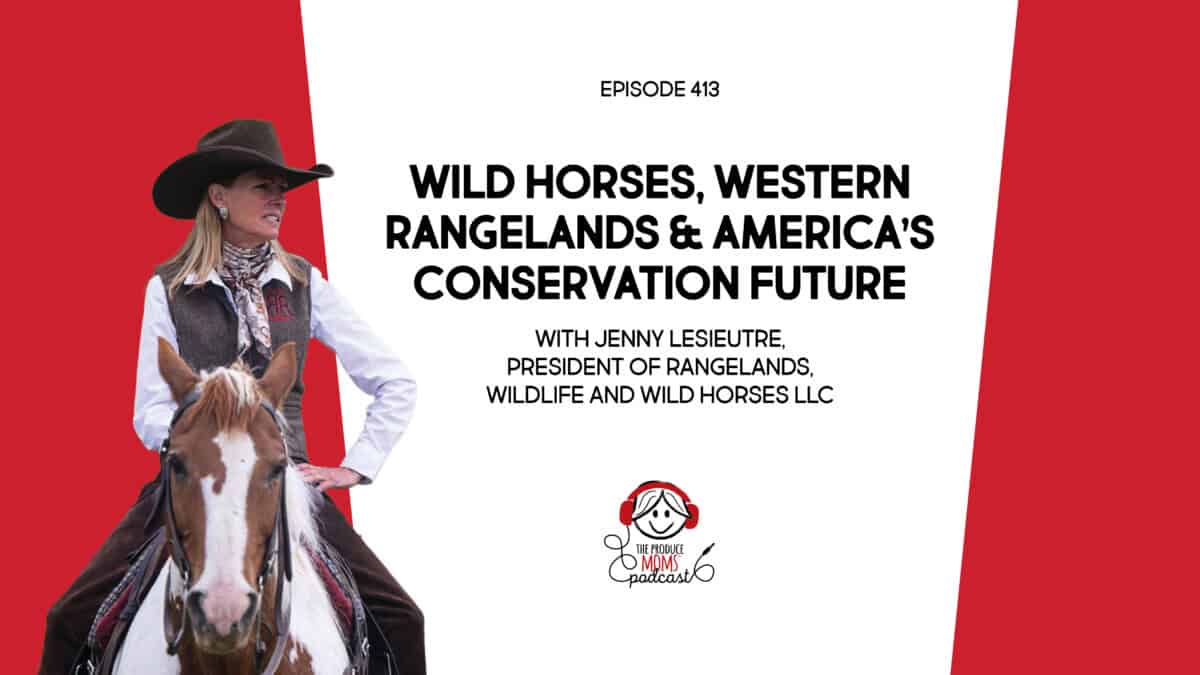
Episode 413: Jenny Lesieutre

Nov 11, 2026
This post may contain affiliate links. Please read our disclosure policy.
Summary:
In this episode of The Produce Moms Podcast, host Lori Taylor welcomes Jenny Lesieutre, President of Rangelands, Wildlife and Wild Horses LLC, and board member of the Coalition for Nevada’s Wildlife and the Reno Rodeo Association, for an eye-opening conversation about wild horse management, conservation, and the delicate balance required to protect America’s Western rangelands.
With 20 years of federal government experience, including 18 years with the Bureau of Land Management (BLM), Jenny brings a unique perspective to one of the most complex and often misunderstood issues in American agriculture and wildlife conservation. Drawing on her experience living and working in Nevada, she explains how wild horse populations, limited water resources, declining forage, and competing wildlife needs are interconnected.
Together, Lori and Jenny explore the history of the 1971 Wild Free-Roaming Horses and Burros Act, how appropriate management levels are established, and why current wild horse populations have far exceeded what the land can sustainably support. Jenny explains how overpopulation affects not only wild horses but also native wildlife, vegetation, water sources, ranching communities, and the long-term health of Western ecosystems.
The conversation also tackles some of the most controversial aspects of wild horse management, including adoption programs, long-term holding facilities, fertility control, sterilization, and the debate surrounding commercial processing. Jenny discusses the financial realities of managing the program, the challenges facing federal agencies, and why she believes existing laws need to be followed as written to restore a thriving natural ecological balance.
Beyond the wild horse debate, this episode highlights a much bigger agricultural issue: responsible stewardship of our natural resources. From protecting springs and native forage to preserving habitat for more than 900 wildlife species, Jenny reminds us that conservation requires looking at the entire ecosystem rather than focusing on a single animal or issue.
Whether you’re a rancher, grower, wildlife enthusiast, or consumer who cares about where our food comes from, this conversation challenges us to look beyond emotional headlines, understand the realities of land management, and recognize why balanced conservation is essential to America’s agricultural and environmental future.
Takeaways:
- The 1971 Wild Free-Roaming Horses and Burros Act established federal responsibilities for managing wild horses and burros on designated public lands.
- The Bureau of Land Management (BLM) and U.S. Forest Service oversee wild horse management across 10 Western states.
- Nevada faces unique conservation challenges, with approximately 68% of its land federally managed and only 8–10 inches of annual rainfall.
- Appropriate Management Levels (AMLs) are designed to establish how many wild horses and burros the land can sustainably support while maintaining ecological balance.
- As of March 1, 2026, BLM estimated more than 85,000 wild horses on the range, compared with an appropriate management level of nearly 26,000.
- Overpopulation places pressure on limited water sources, native forage, vegetation, and the habitat of other wildlife species.
- Wild horses compete for essential resources shared by mule deer, elk, antelope, and hundreds of other wildlife species.
- The spread of invasive cheatgrass contributes to wildfire risks and makes restoring healthy native vegetation increasingly difficult.
- Federal spending on the BLM Wild Horse and Burro Program has grown substantially, with long-term holding facilities accounting for a significant portion of the program’s budget.
- Adoption and sale programs are important management tools, but challenges surrounding transportation, ownership titles, training, and long-term care complicate the process.
- Fertility control can be useful in certain herd management areas, but it does not immediately reduce existing populations or resolve current resource pressures.
- Jenny emphasizes that conservation decisions must consider the health and well-being of the entire ecosystem, not just one species.
- Collaboration among conservation organizations, sportsmen’s groups, ranchers, and government agencies is essential to restoring balance on public lands.
- Jenny believes Congress should address existing budget restrictions and allow the current law to be implemented as written.
- Responsible wildlife management protects natural resources, supports rural communities, and helps preserve America’s agricultural and conservation heritage.
Chapters:
00:00 – Welcome & Introducing Jenny Lesieutre
02:20 – Jenny’s Background & Passion for Western Conservation
05:50 – The Connection Between Agriculture, Wildlife & Natural Resources
08:00 – Understanding Nevada’s Water & Rangeland Challenges
10:45 – What Are BLM Wild Horses?
12:15 – The History of Wild Horse Protection & the 1971 Act
15:50 – Understanding Appropriate Management Levels (AMLs)
17:45 – Wild Horse Roundups, Adoption & Federal Management
22:25 – What the Law Actually Requires
23:20 – Wild Horse Population Numbers & the Growing Crisis
26:00 – Ecological Balance: Food, Water & Wildlife
29:00 – The Financial Cost of Wild Horse Management
32:20 – Long-Term Holding Facilities & Adoption Challenges
38:00 – Commercial Processing & the Debate Over Resource Use
41:20 – Adoption, Sale & Potential Management Solutions
48:20 – Why the United States Imports Horse Meat
51:20 – Wild Horse Health, Forage & Winter Survival
53:40 – Water Scarcity & Its Impact on Western Wildlife
54:50 – Invasive Cheatgrass & Wildfire Risks
56:20 – Sterilization vs. Fertility Control
1:00:00 – The Limitations of Fertility Control Programs
1:05:00 – Finding Practical Solutions Through Conservation
1:08:00 – What Needs to Change in Wild Horse Management
1:12:00 – The Economic Impact of Wildlife & Rangeland Conservation
1:15:20 – Final Thoughts & Where to Follow Jenny
Resources:
LinkedIn: Jenny Lesieutre | LinkedIn