New Mexico Agriculture

Oct 06, 2026

This post may contain affiliate links. Please read our disclosure policy.
Farming in New Mexico grew out of ingenious ancient traditions. They cultivated crops in the arid landscape over 2,500 years ago. They pioneered “Three Sisters” companion planting, placing corn, beans, and squash together so the stalks supported climbing vines while broad leaves shaded the soil to lock in moisture.
When Spanish settlers arrived in the 16th century, they integrated these indigenous techniques with European livestock and introduced acequias, community-managed gravity canals. This communal irrigation movement transformed dry valleys into fertile oasis ribbons. It also established a resilient farming culture that still flows through the state today.
Today, agriculture forms a powerhouse pillar of New Mexico’s economy. It generates over $50 billion in total economic impact and supports more than 265,000 jobs statewide. Sprawling across roughly 40 million acres of farmland, the state balances small, multi-generational family farms. They make up about 95% of all operations. Most are with large-scale livestock ranches. Open pasture land accounts for nearly 90% of agricultural terrain, making dairy and cattle the top cash commodities driving local rural economies.
Beyond livestock, New Mexico enjoys national fame for its iconic specialty crops. The state leads the nation in chile pepper production and stands as a major grower of pecans, onions, and hay.
Modern growers continually adapt by pairing centuries-old water management wisdom with cutting-edge drip irrigation and soil conservation practices. This blend of deep historical roots and adaptive technology ensures that New Mexico continues to nourish both local communities and dinner tables across the country.
About the New Mexico Department of Agriculture
The New Mexico Department of Agriculture (NMDA) serves as a vital bridge between producers and consumers. They work to promote a fair marketplace, protect natural resources, and grow the state’s vibrant food and agricultural economy.
It operates under the umbrella of New Mexico State University. The department carries out a unique constitutional mandate: it drives agricultural business development while enforcing state standards that protect fair competition and public health. Through programs like “Taste the Tradition®,” NMDA actively markets New Mexico’s iconic specialty crops, such as green chile, pecans, and onions, to regional, national, and international markets.
To fulfill its broad mission, NMDA oversees a wide spectrum of regulatory and educational responsibilities across the state. It is run by the current Director/Secretary. Specialist teams conduct rigorous inspections of commercial feed, seeds, fertilizers, pesticides, and dairy facilities to ensure food safety and consumer protection.
The department also operates state-of-the-art laboratories. These include petroleum, seed, metrology, and veterinary diagnostic facilities. They help to verify commercial scales, ensure fuel quality, and monitor animal health threats like New World screwworm. Additionally, NMDA leads critical environmental initiatives. They support local soil and water conservation districts, manage invasive weeds, and administer programs that help farmers adopt sustainable, water-smart growing techniques.
Learn more at https://nmdeptag.nmsu.edu/.
Top 5 Agricultural Commodities in New Mexico
New Mexico’s agricultural landscape generates over $3 billion in direct farm receipts annually. It blends rich culinary heritage with high-volume livestock production. Though famous for its distinctive desert crops, the state relies heavily on both animal agriculture and specialized crop farming to power its rural communities and feed markets across the United States.
Dairy and Milk
Milk stands as New Mexico’s undisputed top agricultural cash commodity. It generates over $1.2 billion annually. It is concentrated largely in the eastern high plains. Dairy farming fuels local rural economies and supplies major regional processing plants that turn raw milk into cheese, butter, and milk powder. Nationally, the state consistently ranks among the top milk producers in the country.
Cattle and Calves
Cattle and calf production serves as the backbone of New Mexico’s rural culture and land use. It brings nearly $900 million to $1 billion into the state each year. Pasture and rangeland account for nearly 90 percent of the state’s total agricultural acreage. This makes livestock grazing the primary driver for local economies across almost every county. On a national level, New Mexico functions as a critical feeder calf supplier, shipping young cattle to feedlots and processing facilities throughout the High Plains and Midwest. This thriving sector builds directly on a 400-year-old ranching heritage, preserving one of the oldest livestock traditions in North America.
Pecans
Pecans represent New Mexico’s premier specialty crop. It brings in anywhere from $180 million to $220 million annually. Thriving primarily in the sunny, irrigated river valleys, pecan orchards drive local economic growth and support a robust processing and export trade. On the national stage, New Mexico regularly competes with Georgia for the title of top pecan-producing state. It frequently accounts for nearly one-third of total U.S. production.
Related: How To Toast Pecans
Hay (Alfalfa & Mixed Grasses)
Hay generates between $150 million and $180 million annually. It is a crucial cash crop that supports the state’s broader agricultural machinery. Locally, high-protein alfalfa and grass hay directly supply the state’s massive dairy herds and beef cattle operations. This keeps feed costs stable for local producers. Nationally, New Mexico hay plays a key role in the southwestern feed market. They supply neighboring dry states that face forage shortages. Thanks to long growing seasons, intense desert sunlight, and low humidity, farmers in southern river valleys can harvest up to five or six cuttings of high-quality hay in a single year.
Chile Peppers (Red and Green)
While its direct farm-gate value ranges from $45 million to $50 million, the chile pepper exerts an outsized economic and cultural influence that generates hundreds of millions more through processing, tourism, and food manufacturing. Locally, green and red chiles define New Mexico’s identity. They serve as the official state vegetable,alongside the pinto bean. They also inspire the state question: “Red or Green?” Nationally, New Mexico produces over 60 percent of all U.S.-grown chile peppers.
Fruits and Vegetables from New Mexico
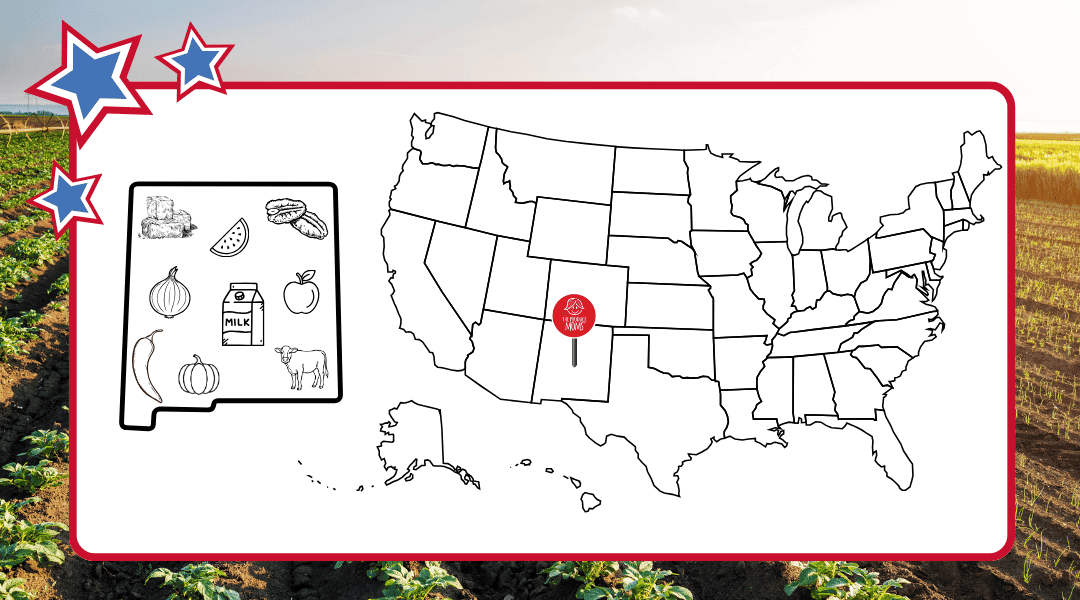
New Mexico’s high-desert climate, intense sunshine, and cold winters create an ideal environment for cultivated specialty crops. While animal agriculture drives overall volume, fruit and vegetable farming provides crucial economic diversification. And helps to define the state’s culinary identity. Specialty crops generate hundreds of millions of dollars in direct sales each year. And supports thousands of regional agricultural jobs. Botanically, tree nuts and traditional orchard harvests lead the fruit category in crop value and total yield. And vegetables form the backbone of the state’s fresh produce sector, led by two major crops that ship across the entire continent.
Top Fruits
- Pecans: Pecans dominate New Mexico’s fruit crop value. Pecan production often exceeds 90 million pounds per year, representing over 30% of total U.S. pecan output. Each year it is either #1 or #2 pecan-producing state in U.S. by brining in 180M-220M annually.
- Apples: Apple orchards hold deep historical roots in northern New Mexico valleys. Like many states, apples anchor northern agritourism and local farmers markets. They bring in $3-$5 million dollars annually.
- Watermelons: Grown in warm southern and eastern counties, commercial watermelon production supplies fresh markets across the Southwest during peak summer months. It provides vital cash flow for mid-sized family farms. They bring in $2M-$4M annually.
Top Vegetables
- Chile Peppers: In recent seasons, New Mexico harvested over 50,000 tons of chile peppers. They bring in $45M–$50M annually and are ranked #1 in the U.S.
- Onions: Summer onions (yellow, red, and sweet varieties) represent one of the state’s most lucrative field crops. Grown heavily in southern New Mexico, these harvests fill a crucial gap in the national supply chain between spring and fall harvest windows in other states. They bring in $35-$50 million annually.
- Pumpkins: New Mexico pumpkin farms supply fall wholesale markets across neighboring states while powering seasonal agritourism events locally. They bring anywhere between $4-$7 million each year.
Visit our Produce Directory and learn how to Select, Store and Serve these fruits & vegetables.
About 50 States of Agriculture
In celebration of 250 years of the United States, The Produce Moms is proud to present 50 States of Agriculture. This is an educational and free resource that celebrates the bounty of America. We utilized USDA and State Department of Agriculture data (New Mexico) for the content in this series.
Agriculture is the foundation of freedom. Food security is national security. This content series is a celebration of United States culture and the hard-working farmers who feed, fuel & clothe our nation and the world.
Visit another state from our 50 States of Agriculture.