Massachusetts Agriculture

Aug 28, 2026

This post may contain affiliate links. Please read our disclosure policy.
Massachusetts farming traces its roots back to Indigenous practices and early European settlers. In the early years, they relied heavily on community effort and shared knowledge. To boost regional technique, leaders founded the Massachusetts Society for Promoting Agriculture in 1792, one of the earliest agricultural societies in the country.
By the 19th century, the state carved out distinct specialties from the fertile Connecticut River Valley to the glacial bogs of Southeastern Massachusetts and Cape Cod. This area provided the ideal home for wild-growing cranberries. Commercial cranberry farming bloomed into an iconic local industry, turning the Bay State into a world leader in tart red fruit production.
As industrial hubs expanded and large-scale Midwestern farming dominated grain markets, Massachusetts pivoted toward high-value, specialized agriculture. Today, agriculture accounts for over $600 million in annual product market value across roughly 7,000 active farms, spanning over 460,000 acres. The state excels in greenhouse and nursery products. It makes up more than a third of the state’s total farm output.
In recent decades, the state has embraced modern agricultural movements focused on sustainability, local eating, and community connection. Massachusetts boasts a vibrant farm-to-table culture. Although the average farm size is relatively small at about 66 acres, the Bay State ranks high nationally in direct-to-consumer farm sales. Supported by strong local demand and growing ranks of new and beginning farmers, modern Massachusetts agriculture successfully bridges its deep historic roots with progressive, eco-friendly food systems.
About the Massachusetts Department of Agricultural Resources
The Massachusetts Department of Agricultural Resources (MDAR) serves as the state’s primary engine for supporting and protecting local agriculture. It is guided by its core mission. They work to cultivate a robust and equitable agricultural economy, promote a safe and resilient food system, and preserve a healthy environment for Massachusetts farmers, animals, and consumers alike.
The department balances its role as a supportive partner with state regulatory responsibilities, overseeing essential areas such as food safety policies, animal health standards, pesticide licensing, and crop protection.
At its heart, MDAR acts as a lifeline for a wide range of state stakeholders that is overseen by an appointed Commissioner. It directly supports traditional, urban, and modern farmers through financial grants, climate resiliency funding, and technical assistance aimed at helping operations stay economically viable.
Programs like the Agricultural Preservation Restriction (APR) help preserve precious farmland from residential development, while initiatives like “MassGrown” actively connect everyday consumers to local farm stands, CSAs, and farmers’ markets. By championing eco-friendly farming practices and fostering direct-to-consumer relationships, MDAR ensures that the Bay State’s unique agricultural landscape continues to thrive,
Learn more at https://www.mass.gov/orgs/massachusetts-department-of-agricultural-resources.
Top 5 Agricultural Commodities in Massachusetts
Massachusetts agriculture thrives on specialization, leaning into high-value niche crops and fresh local perishables rather than large-scale land commodity crops like wheat or soybeans. Generating over $600 million in annual agricultural receipts, the Bay State pairs historical tradition with modern suburban demand.
Greenhouse & Nursery Products
It is the top agricultural revenue driver, and it dominates the state’s farm sales. Greenhouse and nursery products account for more than one-third of total agricultural market value. It also powers local residential landscaping, urban gardens, and commercial developments across New England.
Cranberries
Massachusetts is the #2 producer in the U.S. (behind Wisconsin). Bogs cover over 12,000 acres in Southeastern MA and Cape Cod, making cranberries the state’s signature export fruit. The commercial cranberry production generates tens of millions of dollars annually
Aquaculture & Shellfish
Driven primarily by high-end oyster cultivation along Cape Cod, Martha’s Vineyard, and the South Shore, marine farming is one of the state’s fastest-growing agricultural sectors. Utilizing tidal estuaries and cold, nutrient-rich coastal waters, Massachusetts shellfish growers supply top-tier seafood restaurants nationwide. The industry also provides vital economic stability to historic maritime communities, creating year-round coastal jobs
Dairy Products
While the number of commercial herds has consolidated over time, family-operated dairy farms remain anchored throughout Central Massachusetts and the Pioneer Valley. Local dairies play a critical role in regional food security, producing fresh fluid milk for New England processors and schools. Many operations have diversified into value-added products like artisanal cheeses, farm-fresh ice cream, and butter, marketing directly to local consumers.
Apples
Massachusetts fruit and vegetable orchards are the backbone of the state’s direct-to-consumer farm network. Multi-generational orchards cultivate dozens of heritage and modern apple varieties fueling a fall agritourism boom centered on pick-your-own events, fresh cider, and cider donuts.
Fruits and Vegetables from Massachusetts
While Massachusetts is famous for its dense urban centers and historic coastline, its produce farms play a vital role in feeding the region and driving state agricultural revenue. Because land availability is limited compared to the expansive Midwest, Bay State fruit and vegetable growers focus on high-value, highly perishable crops that thrive in New England’s soil and temperate climate.
Top Fruits
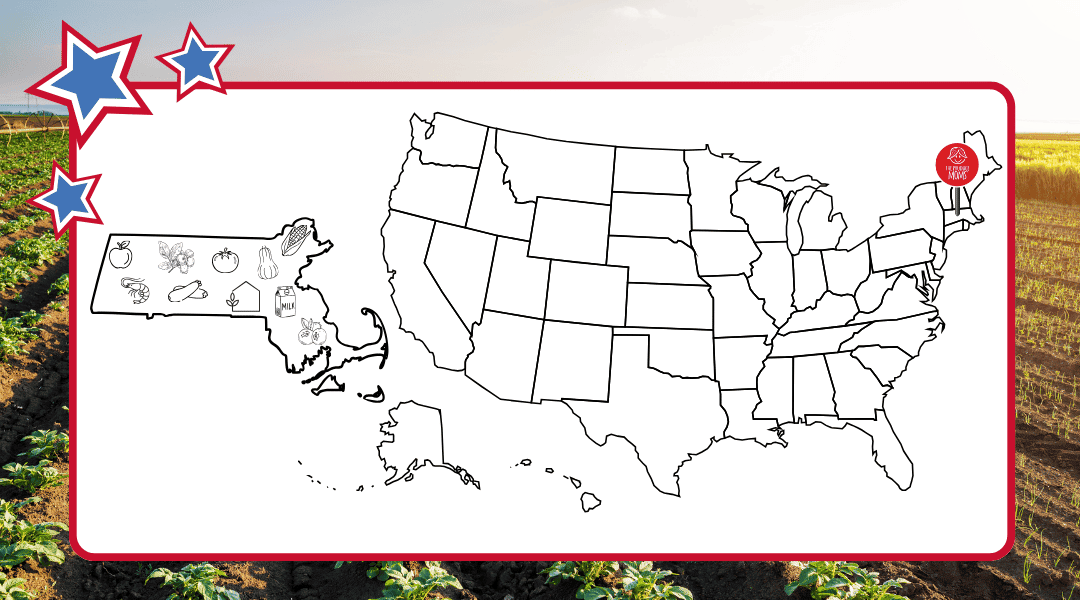
- Cranberries: Cranberries are Massachusetts’ undisputed crown jewel of fruit production. They rank as the second-largest producer in the nation behind Wisconsin. They are grown primarily in the man-made bogs of Southeastern Massachusetts and Cape Cod
- Apples: Apples represent the state’s most significant tree-fruit crop. They generate tens of millions of dollars across more than 1,000 orchard farms. The tradition dates back to the 1620s when early settlers planted the first U.S. apple trees in the Massachusetts Bay Colony.
- Blueberries: Both wild lowbush and cultivated highbush blueberries thrive in Massachusetts’ naturally acidic, glacial soils. Ranking right behind apples in non-cranberry fruit value, blueberries are a staple summer crop harvested from July through August.
Top Vegetables
- Sweet Corn: Sweet corn leads Massachusetts’ vegetable sector in sheer acreage. There are thousands of acres harvested annually across the state. It is grown heavily throughout the fertile Pioneer Valley along the Connecticut River. Sweet corn is synonymous with summer in New England.
- Squash (Winter & Summer): Squash is a premier specialty crop for the Bay State. It is native to North America and has been cultivated here for centuries. Winter squash is particularly valuable because its thick skin allows it to store easily through cold New England winters. Local squash crops generate critical late-season revenue for diversified fresh-market vegetable farms.
- Tomatoes: Tomatoes are a high-value cornerstone of Massachusetts’ fresh-produce landscape. Raised both in open fields during the peak of summer and in climate-controlled greenhouses year-round, local tomatoes command premium prices at farmers’ markets and grocery stores. They are a critical income generator for small-scale, diversified farms that rely on direct sales to local households and chefs.
Visit our Produce Directory and learn how to Select, Store and Serve these fruits & vegetables.
About 50 States of Agriculture
In celebration of 250 years of the United States, The Produce Moms is proud to present 50 States of Agriculture. This is an educational and free resource that celebrates the bounty of America. We utilized USDA and State Department of Agriculture data (Massachusetts) for the content in this series.
Agriculture is the foundation of freedom. Food security is national security. This content series is a celebration of United States culture and the hard-working farmers who feed, fuel & clothe our nation and the world.
Visit another state from our 50 States of Agriculture.