Kentucky Agriculture

Aug 12, 2026

This post may contain affiliate links. Please read our disclosure policy.
Kentucky’s agricultural story begins in its mineral-rich soil. This was where early settlers discovered that the underlying limestone filtered local water and fortified the pasturelands. This unique geology laid the groundwork for two early signature traditions: growing corn to distill distinct regional whiskies and breeding powerful livestock.
For nearly two centuries, burley tobacco served as the financial backbone of Kentucky. It provided a reliable cash crop that sustained small family farms across nearly every county.
A major turning point arrived in the late 1990s and early 2000s with the federal tobacco buyout. It prompted one of the most successful agricultural shifts in modern American history.
Kentucky farmers quickly diversified into broad-acre crop production and livestock expansion. Today, corn and soybeans cover millions of acres across the state’s rolling plains. Plus, poultry production and beef cattle have grown into major economic drivers. In fact, Kentucky now holds the distinction of being the top beef-producing state east of the Mississippi River.
In the modern era, the state balances a massive commercial footprint with a deep commitment to family-owned heritage. Kentucky is home to over 67,000 individual farm operations covering roughly 12.3 million acres. Family operations making up over 90% of all farms.
Known worldwide as the “Horse Capital of the World,” the equine industry, spanning thoroughbred breeding, training, and racing, generates an estimated $4 billion in direct economic impact alone. Combined with crop harvests and livestock sales, agriculture yields more than $8 billion in farm market value annually and supports a total statewide economic impact of roughly $45 billion.
About the Kentucky Department of Agriculture
The Kentucky Department of Agriculture (KDA) serves as the Commonwealth’s primary administrative agency dedicated to expanding agricultural commerce, safeguarding food systems, and advancing the state’s rural economy.
Led by an elected Commissioner of Agriculture, the department operates at the intersection of consumer protection, farm development, and environmental stewardship. Its core mission centers on promoting Kentucky’s vibrant farm economy, regulating agricultural trade, ensuring accurate weights and measures, and certifying local food and fiber products to compete in both national and global markets. Beyond market expansion, the agency protects animal and plant health, enforces safety standards across pesticide and feed applications, and manages state fair and promotional programs that celebrate the state’s agrarian heritage.
To fulfill this mission, the KDA directly supports a wide variety of stakeholders, from large-scale grain growers and livestock producers to small-family operations, agribusinesses, and everyday consumers. Through flagship marketing initiatives like Kentucky Proud, the department connects local growers directly to restaurants, grocery chains, and school districts, while simultaneously assuring consumers that the food on their tables meets rigorous safety and quality standards.
Learn more at https://www.kyagr.com/.
Top 5 Agricultural Commodities in Kentucky
Kentucky’s agricultural landscape generates over $8 billion in annual farm market value across roughly 12.3 million acres of farmland. Driven by over 67,000 predominantly family-owned operations. With a combination of ideal geography, climate, and strategic access to major river transportation networks sustains many commodities that drive local economies while supplying critical food, grain, and livestock markets across the globe.
Poultry
Specifically broiler chickens and table eggs serve as Kentucky’s top grossing agricultural commodity. It generates upwards of $1.5 billion annually in cash receipts. Concentrated heavily in the central and western regions of the state, the industry supports hundreds of family farms and extensive local processing networks. Locally, poultry creates a vital economic synergy by acting as the largest domestic consumer of Kentucky-grown grain. It uses roughly 20% to 25% of the state’s corn crop for feed. On a national scale, Kentucky consistently ranks among the top 10 broiler-producing states. It supplies food retailers and export channels with high-grade poultry products and over one billion eggs each year.
Soybeans
Soybeans represent Kentucky’s top row crop. It generates over $1.2 billion annually as a critical pillar of both the state’s farm economy and global trade. They supply vital livestock feed and bio-fuel feedstock. Locally, processing plants extract meal for regional livestock feed and oil for industrial and food uses. Nationally and internationally, Kentucky’s strategic position along the Ohio and Mississippi Rivers enables grain elevators to seamlessly export tens of millions of bushels directly to foreign markets. This makes Kentucky an essential link in the global agricultural supply chain.
Beef Cattle
Beef cattle production is a cornerstone of Kentucky’s rural identity. It yields around $1 billion in annual sales. Kentucky holds the largest beef cattle herd of any state east of the Mississippi River. With operations spanning all 120 counties, small and medium-sized family farms dominate the sector. They rely on the state’s abundant rainfall and forage pastures. Nationally, Kentucky operates primarily as a premier “cow-calf” state. They raise healthy calves that are later shipped to Western feedlots and backgrounding operations to supply beef processing markets across the United States.
Corn
Corn closely rivals soybeans as a major grain crop. It produces roughly $1 billion in farm market value each year across more than 1.5 million harvested acres. Beyond providing the primary energy source for local poultry, livestock, and regional ethanol plants, Kentucky corn plays a famous role in the state’s heritage economy. By federal definition, Bourbon must be distilled from a grain mixture containing at least 51% corn, meaning Kentucky’s corn harvest directly powers the state’s multi-billion-dollar signature distilling industry alongside national grain markets.
Equine
Equine production which includes Thoroughbreds, Standardbreds, and sporting breeds is Kentucky’s most internationally recognized agricultural sector. It generates roughly $1 billion in direct livestock receipts. Plus it anchors a broader $4 billion economic ecosystem. Centered in the world-famous Bluegrass region around Lexington, the mineral-rich limestone soil builds strong bones in young horses. This makes it the premier global hub for breeding, sales, and athletic training. From hosting the Kentucky Derby to attracting multi-million-dollar international bidding at Keeneland auctions, the Commonwealth’s equine industry sets the national standard for horse racing and elite livestock breeding.
Fruits and Vegetables from Kentucky
Kentucky’s specialty crop sector brings vital diversity and high-value yield to the Commonwealth’s agriculture. It generates tens of millions of dollars in fresh market sales each year. It’s driven by thousands of family farms, high-tunnel innovations, and an expanding network of direct-to-consumer farm stands. Fresh fruits and vegetables play a key role in sustaining local food systems and seasonal agritourism.
Top Fruits
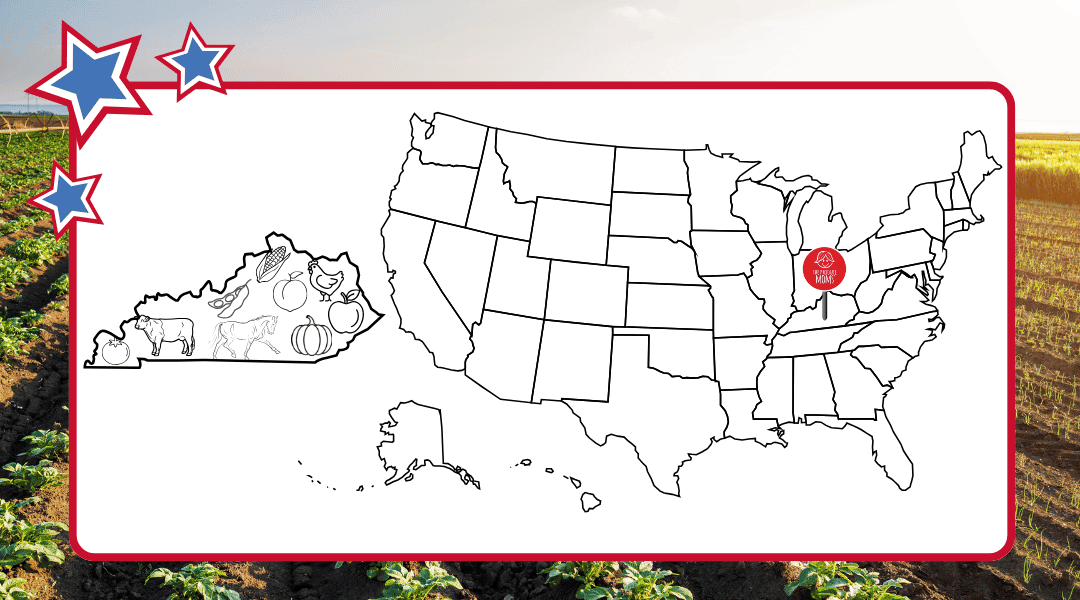
- Apples: Orchard production has a long-standing heritage in Kentucky. They have commercial and u-pick orchards flourishing along the Ohio River valley and throughout Central Kentucky.
- Peaches: Stone fruit orchards thrive in Western and Central Kentucky where sunny summer conditions yield high-value fresh-market crops. Though susceptible to early spring frosts, Kentucky peaches fetch high premiums at local markets and road stands from mid-to-late summer.
- Strawberries: Strawberries lead the state’s small-fruit production. Strawberries account for a smaller total acreage compared to row crops like corn or soybeans. They pack an exceptionally high economic punch per acre for Kentucky’s small family farms. As the earliest major fruit crop to mature each spring, strawberries serve as a critical early-season cash flow driver and a cornerstone of the state’s agritourism industry.
Top Vegetables
- Tomatoes: They are considered the cornerstone crop of Kentucky vegetable farming. Tomatoes are grown across both open field acreage and climate-controlled high tunnels.
- Sweet Corn: Planted extensively across the river bottoms and rolling fields of the state, sweet corn serves as a favorite summer staple. Harvesting from July through August, growers supply local farm markets and regional wholesale distributors, making sweet corn one of the highest-volume fresh vegetables sold directly to consumers.
- Pumpkins: Cultivated on thousands of acres statewide, pumpkins represent a major fall specialty crop that powers Kentucky’s fall agritourism industry. From jack-o’-lantern varieties to ornamental gourds and winter squash, pumpkin patches draw visitors to rural communities every September and October, providing crucial seasonal income for family farms.
Visit our Produce Directory and learn how to Select, Store and Serve these fruits & vegetables.
About 50 States of Agriculture
In celebration of 250 years of the United States, The Produce Moms is proud to present 50 States of Agriculture. This is an educational and free resource that celebrates the bounty of America. We utilized USDA and State Department of Agriculture data (Kentucky) for the content in this series.
Agriculture is the foundation of freedom. Food security is national security. This content series is a celebration of United States culture and the hard-working farmers who feed, fuel & clothe our nation and the world.
Visit another state from our 50 States of Agriculture.