Delaware Agriculture

Jun 24, 2026, Updated Jul 16, 2026
This post may contain affiliate links. Please read our disclosure policy.
Delaware may be the second-smallest state in the nation, but its agricultural footprint is incredibly mighty. Farming has been the heartbeat of the “First State” for centuries.
By the late 1800s, Delaware was the leading peach producer in the country. It’s a legacy proudly remembered today through its official state flower, the peach blossom. When a sudden plant disease hit the orchards at the turn of the 20th century, the state’s resilient farmers adapted, pivoting toward fresh strawberries, tomatoes, and a new kind of history-making venture.
That turning point came in 1923 in Sussex County, thanks to a woman named Cecile Steele. Looking for a way to supplement her family’s income, she experimented with raising a larger-than-normal flock of chickens. Her success led to the modern American “broiler” (meat chicken) industry.
Step onto a Delaware farm today, and you will find an intricate dance between livestock and crops. To feed all those chickens, local farmers planted massive fields of corn and soybeans. Beyond grain, Delaware is a massive supplier of fresh fruits and vegetables for the East Coast.
What makes Delaware’s farming community truly special is its heart. Even with all of this high-volume food production, about 90% of the state’s farms remain small, family-owned operations. Many of these families have been tilling the exact same soil for generations. They have well over 100 officially recognized “Century Farms” that have stayed in the same family for over a century. It is a beautiful blend of deep family heritage and modern innovation. This tiny state will keep feeding millions of everyday consumers for generations to come.
About Delaware Department of Agriculture
The Delaware Department of Agriculture (DDA) has been a steadfast ally to the state’s farming community for well over a century. Established in 1899 as the State Board of Agriculture, it was created during a challenging era when local farmers were fighting devastating crop diseases and rapidly shifting markets.
Today, its core mission is simple yet vital: to sustain and promote Delaware agriculture while ensuring a safe food supply and a healthy environment for everyone. By offering marketing support, providing financial loans, and funding cutting-edge agricultural research, the DDA acts as a protective shield and an economic engine for the family-run operations that form the backbone of the state’s rural economy. You can learn more from the Office of the Secretary.
While the department works hand-in-hand with farmers, its role is equally important in the daily lives of everyday consumers. From the grocery store aisles to local gas stations, the DDA quietly ensures fairness and safety across the state. Their dedicated teams inspect and test everything from the health of livestock and poultry to the precision of the weights and measures on grocery scales and fuel pumps.
Furthermore, through forward-thinking initiatives like the Delaware Aglands Preservation Program, the department has permanently saved more than 150,000 acres of farmland from urban development. This vital work guarantees that local families can continue to enjoy fresh, Delaware-grown food while preserving the scenic, open spaces that make the First State feel like home.
Learn more at https://agriculture.delaware.gov/.
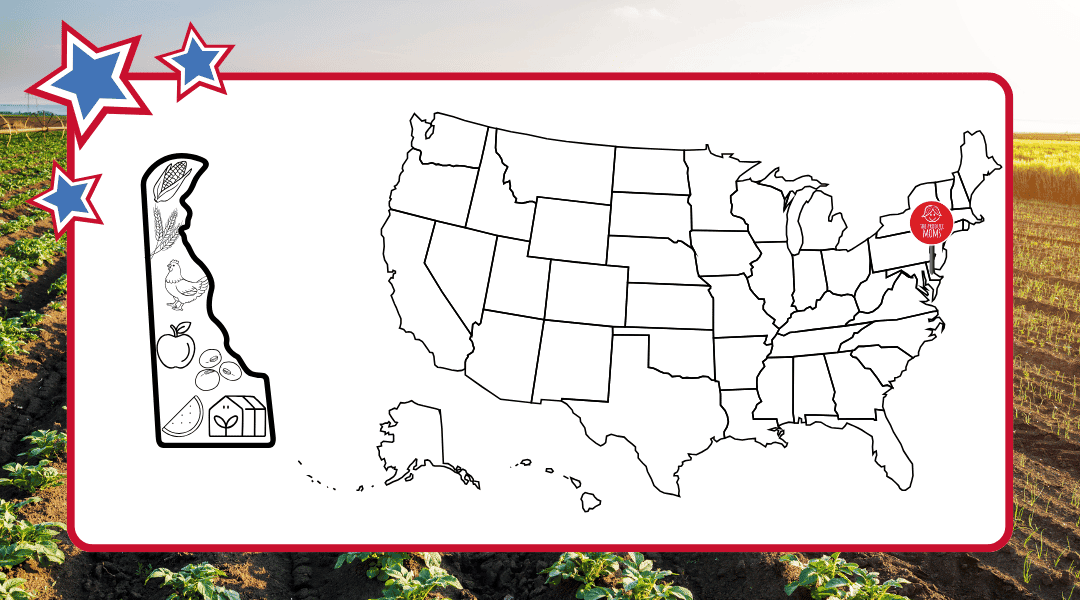
Top 5 Agricultural Commodities in Delaware
Despite its compact geography, Delaware’s agricultural sector drives billions of dollars in economic activity. About 39% of the state’s total land area (roughly 500,000 acres) is dedicated to thriving farms. Livestock and crops exist in a beautifully interconnected loop.
Broiler Chickens
Broiler chickens (chickens raised for meat production) are the undisputed number one. This single commodity consistently accounts for over 70% of the state’s total agricultural cash. It brings in upwards of $2 billion to $3 billion annually. The impact of this industry ripples far beyond the farm. It also supports over 13,000 local jobs in processing, feed manufacturing, and transportation.
Corn (for Grain)
Corn is Delaware’s number-one crop by acreage and total production value. In a typical growing season, Delaware farmers plant around 170,000 to 175,000 acres of corn. It yields ver 30 million bushels with a production value that tops $140 million. The brilliance of this crop lies in its hyper-local impact. Nearly all the corn grown in Delaware stays right at home. It serves as the primary ingredient to feed the state’s massive broiler chicken population.
Soybeans
Following closely behind corn, soybeans cover roughly 135,000 to 140,000 acres of Delaware farmland. Generating nearly $70 million in annual value, soybeans are the second critical half of the local poultry feed equation. High-protein soybean meal is blended with local corn to provide optimal nutrition for healthy flocks. Because Delaware’s grain farmers can sell directly to nearby poultry integrators, it keeps transportation costs low and strengthens the economic resilience of the entire local farming community.
Wheat
Modern Delaware farmers harvest around 55,000 acres of wheat annually. It generates millions of dollars in grain revenue while yielding critical straw bedding for the local poultry industry. This efficient double-cropping system allows farmers to maximize their acreage by harvesting winter wheat in early summer just before planting a late-season crop of soybeans.
Greenhouse and Nursery Products
An often-overlooked powerhouse in Delaware’s agricultural portfolio is the greenhouse, nursery, and floriculture sector. Encompassing sod farms, commercial greenhouses, and ornamental shrub nurseries, this industry generates tens of millions of dollars annually. It plays a dual role: it provides high-value landscaping products to support the region’s suburban growth, while supplying beautiful potted plants, flowers, and turfgrass to retail garden centers all across the mid-Atlantic.
Fruits and Vegetables from Delaware
Fruit and vegetable farms spread over nearly 60,000 acres. It is a crucial “foodshed” for the densely populated Northeast. Thanks to rich, sandy coastal soils and advanced irrigation, local family farms produce over $90 million worth of fresh market and processing vegetables annually.
Top Fruits
- Watermelon: It is the undisputed giant of Delaware’s fruit industry. Delaware consistently ranks among the top ten watermelon-producing states in the entire nation, dedicating roughly 2,500 to 3,000 acres to the crop annually. Generating around $10 million to $15 million in annual farm cash receipts.
- Apples: Apples carry an incredibly strong historical and commercial weight in Delaware. Mostly local family orchards grow a diverse mix of varieties ranging from crisp Honeycrisp and Gala to classic Fuji and Granny Smith. Beyond fresh-eating apples sold at roadside farm stands, a significant portion of Delaware’s apple crop feeds the regional processing economy, being converted into local apple cider, applesauce, and baked goods distributed across the mid-Atlantic.
- Peaches: Peaches hold a deeply sentimental and economic place in the First State. Though a devastating plant disease at the turn of the 20th century shrunk the massive commercial acreage of the 1800s, Delaware’s peach industry has experienced a proud, high-quality revival. Today, local family-owned orchards cultivate premium fresh-market peaches.
Top Vegetables
- Lima Beans: It’s known as the signature vegetable, with the state consistently ranking second only to California in national production. Delaware farmers plant approximately 14,000 acres of green baby lima beans every single year. The vast majority of these beans are grown specifically for processing. Because shelled succulent lima beans are incredibly perishable, they are rushed straight from the fields to state-of-the-art freezing and canning facilities right in Delaware, solidifying the state’s critical role in the country’s shelf-stable and frozen food supply chain.
- Sweet Corn: It is a massive favorite for both fresh market consumption and regional processing, blanketing thousands of acres across Delaware. The state harvests a dual supply: fresh-market sweet corn, which floods local roadside stands and grocery aisles across the Mid-Atlantic from July through September, and processing sweet corn contracted by commercial freezing and canning brands. This high-volume production makes a notable economic impact, generating millions of dollars in annual revenue and acting as a crucial seasonal staple for East Coast grocery hubs.
- Green Peas: They represent one of Delaware’s earliest and fastest-moving agricultural success stories each year. Planted as early as late February, peas thrive in the cool Delaware spring before a fast-paced harvest begins in late May and June. Because green peas can transition from perfectly ripe to overmature in less than 24 hours, local processing companies work in a tight, precision-timed dance with farmers to harvest and freeze the crop at peak quality.
Visit our Produce Directory and learn how to Select, Store and Serve these fruits & vegetables.
About 50 States of Agriculture
In celebration of 250 years of the United States, The Produce Moms is proud to present 50 States of Agriculture. This is an educational and free resource that celebrates the bounty of America. We utilized USDA and State Department of Agriculture data (Delaware) for the content in this series.
Agriculture is the foundation of freedom. Food security is national security. This content series is a celebration of United States culture and the hard-working farmers who feed, fuel & clothe our nation and the world.
Visit another state from our 50 States of Agriculture.