Alabama Agriculture

Jun 24, 2026, Updated Jul 16, 2026

This post may contain affiliate links. Please read our disclosure policy.
From its roots in the rich, fertile soil of the American South to the thriving communities of today, Alabama’s journey is a beautiful story of growth, resilience, and transformation.
Officially welcoming neighbors as the 22nd state in 1819, Alabama quickly became a heartland for agriculture. It’s where the famous “Black Belt” region grew to nourish a bustling cotton industry.
While the state’s early history carries the heavy and difficult legacy of the plantation system and the Civil War, the resilience of its people has always paved the way forward. By the late 19th century, Alabama began branching out into industrial roots like iron and steel in Birmingham, showing its incredible ability to adapt, build and grow.
Decades later, the state became the brave heart of the Civil Rights Movement, where monumental moments like the Montgomery Bus Boycott forever changed the nationwide conversation around equality and community.
Today, Alabama is a wonderful blend of old and new. Cherishing its deep agricultural heritage and local farms while proudly stepping into the future as a vibrant hub for automotive and aerospace innovation.
About the Alabama Department of Agriculture & Industries
The Alabama Department of Agriculture and Industries enforces state and federal regulations to ensure fair, prompt, and expert oversight of goods, services, and business operations. Dedicated to safeguarding local consumers, the department also drives economic growth by promoting Alabama-made products both domestically and globally.
Operating on a budget of less than $25 million, the department relies on a dedicated team of 300 full-time and over 250 part-time staff members whose work impacts residents statewide. For more than 120 years, the agency has supported Alabama’s agricultural community and general public, and the Commissioner and staff remain committed to enhancing these vital services in the future.
Learn more at https://agi.alabama.gov/
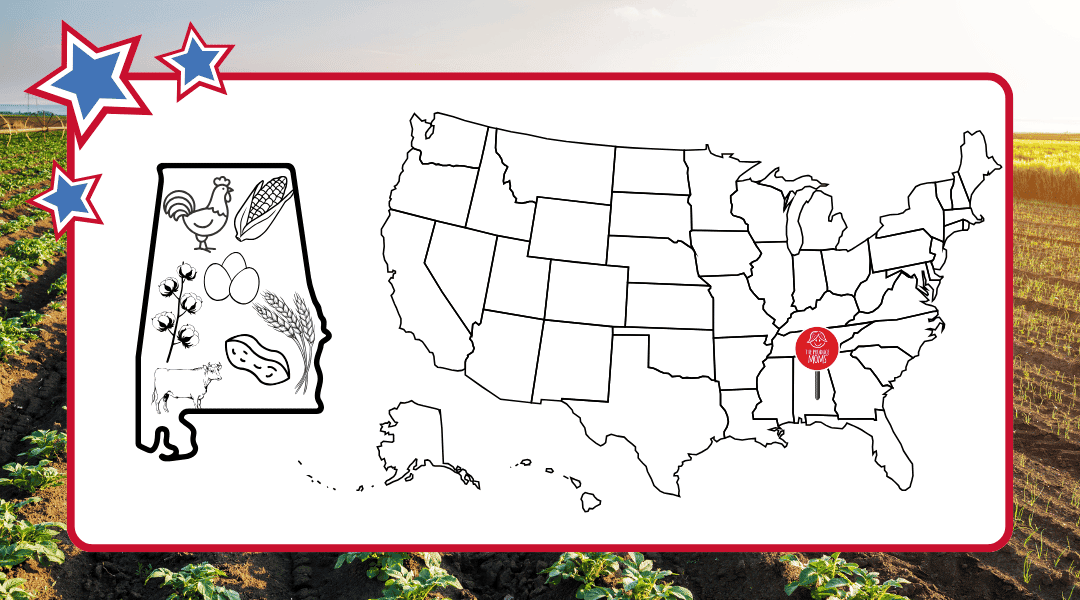
Top 5 Agricultural Commodities in Alabama
Broilers (Meat Chickens)
Broilers are the undisputed backbone of Alabama agriculture. They make up over 50% of the state’s total agricultural receipts. The state routinely ranks as one of the top producers of broiler chickens in the nation.
Chicken Eggs
Following poultry meat, table eggs are the second-largest agricultural commodity in Alabama. They are a top contributor in the national egg supply.
Cattle and Calves
Beef production represents the largest livestock sector outside of the poultry industry. With cattle farms operating in all 67 counties, the state’s expansive pastures support a massive calf-raising industry that generates hundreds of millions of dollars annually for the local economy.
Cotton
Cotton is the highest-ranking and most economically valuable row crop grown in Alabama. The state consistently ranks as a top-10 cotton producer in the U.S. The Cotton State: Dating back to the mid-1800s, Alabama was known as “The Cotton State.” This nickname recognizes Alabama’s historical position as a central part of the Southern “Cotton Belt” and the enormous influence the crop had on the state’s early economy
Corn
Corn remains a vital pillar of the state’s agricultural economy, regularly ranking among its most valuable row crops. Alabama farmers plant hundreds of thousands of acres of corn annually, generating hundreds of millions of dollars to support both local grain markets and the state’s massive poultry industry.
Fruits and Vegetables from Alabama
Alabama has a highly productive specialty fruit and vegetable industry. Thanks to its warm climate, long growing season, and rich soil (especially in the Black Belt and coastal regions). Alabama produces an incredible array of fresh produce.
Top Fruits
- Peaches: Alabama’s leading commercial fruit crop, pulling in millions of dollars in sales annually.
- Blackberries: Officially designated as Alabama’s state fruit. Both wild and cultivated varieties thrive effortlessly across the state.
- Watermelons: Alabama consistently ranks in the top 15 states nationally for watermelon production.
Top Vegetables
- Sweet Potatoes: Arguably Alabama’s most successful commercial vegetable. The state ranks 7th in the nation for sweet potato production, cultivating thousands of acres annually.
- Tomatoes: While grown all over the state, The wiregrass region and parts of North Alabama are famous for their vine-ripened tomatoes.
- Summer Squash & Zucchini: Since they are a major warm-season crop, both summer squash & zucchini are farmed statewide. Because it thrives in the heat, Alabama farmers can often get multiple harvests out of a single season.
Visit our Produce Directory and learn how to Select, Store and Serve these fruits & vegetables.
About 50 States of Agriculture
In celebration of 250 years of the United States, The Produce Moms is proud to present 50 States of Agriculture. This is an educational and free resource that celebrates the bounty of America. We utilized USDA and State Department of Agriculture data (Alabama) for the content in this series.
Agriculture is the foundation of freedom. Food security is national security. This content series is a celebration of United States culture and the hard-working farmers who feed, fuel & clothe our nation and the world.
Visit another state from our 50 States of Agriculture.