Indiana Agriculture

Jul 31, 2026
This post may contain affiliate links. Please read our disclosure policy.
Long before Indiana gained its statehood, the land’s rich, glacial soil was cultivated by Indigenous peoples who grew staple crops like maize, beans, and squash. As European settlers moved into the region throughout the early 19th century, agriculture became the cornerstone of the local economy.
Early farming was labor-intensive and reliant on horses and oxen. However, Hoosier ingenuity quickly sparked major advancements. A turning point came in 1858 when the chilled-iron plow was invented. It was a revolutionary tool that could slice cleanly through heavy Midwestern prairie soil without sticking. Coupled with the expansion of the railroad network around the same time, Indiana farmers gained the ability to ship grain and livestock across the country. It transformed the quiet family homesteads into a vital regional food engine.
The 20th century brought rapid modernization and structural shifts across the state’s agricultural landscape. The 1920s introduced gas-powered tractors to Indiana farms. They gradually replaced draft animals and exponentially increased productivity per acre. Over the decades, agricultural education and research driven by Purdue University helped farmers adopt crop rotation, soil conservation practices, and high-yielding seed varieties.
While the total number of individual farms steadily decreased by consolidating into larger, more specialized family-run operations, the overall production soared. Soybeans, virtually uncropped in Indiana at the turn of the century, rose to become a co-dominant staple alongside corn.
Today, Indiana stands as one of the top ten agricultural states in the nation. It has roughly 14.5 million acres of dedicated farmland. Farmland represents over 60% of the state’s total land area. Modern Hoosier agriculture blends traditional family stewardship with high-tech precision farming.
About the Indiana State Department of Agriculture
The Indiana State Department of Agriculture (ISDA) plays a pivotal role in supporting, expanding, and protecting the state’s vibrant farming community. Established as a state agency by the Indiana Legislature in 2005, the department operates under the umbrella of the Lieutenant Governor, who serves as the state’s Secretary of Agriculture and Rural Development.
With a vision to make Indiana a global leader in food, fuel, and fiber production, ISDA focuses on balancing robust economic growth with long-term environmental stewardship. The agency’s daily work centers around three main pillars: advocacy, economic opportunity, and natural resource conservation.
ISDA acts as a vital voice for Hoosier farmers at the local, state, and federal levels. It helps shape policy and streamline regulatory coordination for agricultural businesses.To bolster economic vitality, the department houses divisions dedicated to international trade, bioenergy, livestock development, and the state’s thriving hardwood industry. It also oversees popular initiatives like “Indiana Grown,” which connects local consumers, producers, and processors.
Environmental health and consumer protection are equally central to ISDA’s mission. Through its Soil Conservation division and partnerships across the state, the agency provides technical and educational resources to help farmers adopt sustainable practices.By combining forward-thinking innovation with a deep respect for farming traditions, ISDA helps ensure that Indiana agriculture remains a powerhouse for generations to come.
Learn more at https://www.in.gov/isda/.
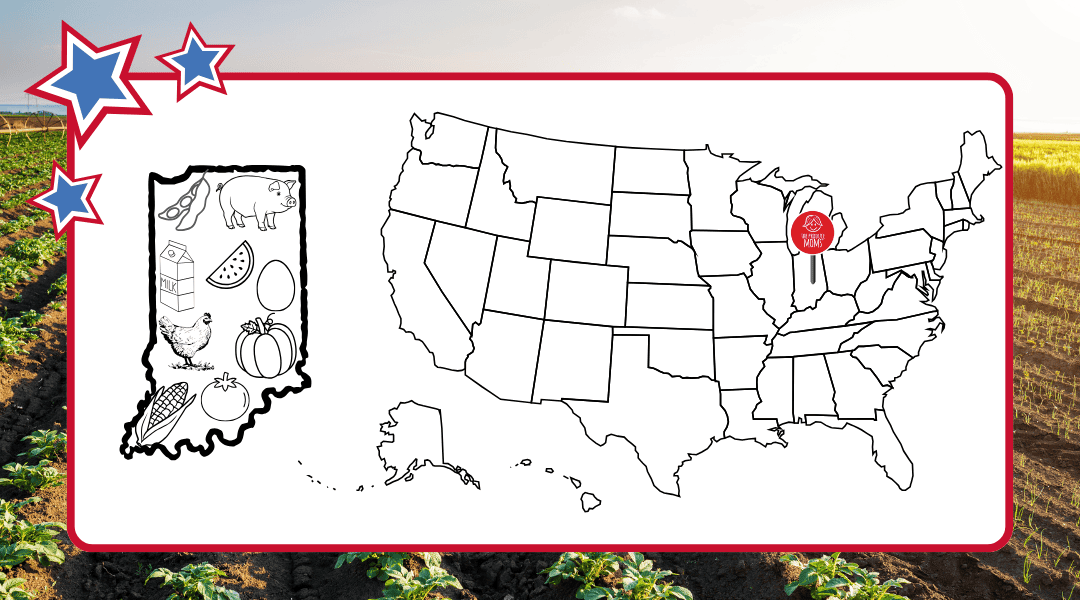
Top 5 Agricultural Commodities in Indiana
The state’s unique mix of fertile glacial soils, favorable climate, and central location creates an ideal environment for both row crops and livestock. Indiana is a powerhouse in American agriculture. It routinely generates billions of dollars in farm cash receipts.
Corn
Corn is Indiana’s highest-earning crop. It brings in over $4 billion annually. Indiana routinely ranks 5th in the nation for corn production. Indiana harvests over 1 billion bushels each year across more than 5 million acres. Corn fuels Indiana’s rural economies, providing livestock feed for local swine and poultry farms. It also serves as the raw material for the state’s robust ethanol processing plants. While field corn dominates the landscape, Indiana is also a leader in a specialty variety: it ranks 2nd in the U.S. for popcorn production, supplying movie theaters and snack aisles nationwide!
Soybeans
Running neck-and-neck with corn in total acreage, soybeans generate around $3.5 to $4 billion annually for Hoosier farmers. Indiana ranks 4th nationally in overall soybean production. They yield over 300 million bushels per year. Soybeans play a crucial role in sustainable crop rotation. Soybeans are the state’s #1 agricultural export, shipped en masse to international markets for animal feed, bio-based fuels, and food products like tofu and vegetable oil.
Poultry & Eggs
Indiana’s poultry industry is a dominant force. It generates roughly $2 billion in cash receipts. The state consistently ranks 3rd in the U.S. for total egg production (approximately 10 billion eggs annually). The poultry sector creates thousands of jobs in processing, packaging, and logistics throughout central and southern Indiana. It also provides a massive local market for Indiana-grown corn and soy feed.
And fun fact…Indiana is also a major national player in other feathered livestock. It ranks 4th in the U.S. for turkey production and 1st in commercial duck production!
Hogs and Pigs
Swine production is the bedrock of Indiana’s meat livestock sector. Indiana holds a firm spot as the 5th largest hog-producing state in the country. Indiana maintains an inventory of around 4.3 to 4.4 million hogs at any given time.
Dairy Products and Milk
Rounding out the top five is Indiana’s dairy industry, which generates over $1 billion annually. With an inventory of roughly 190,000 dairy cows, Indiana dairies produce over 4.5 billion pounds of milk each year. Indiana is known for high efficiency per cow, averaging over 23,000 pounds of milk per cow annually. Thanks to Indiana’s central geography (often called the “Crossroads of America”), dairy processing plants in the state can process milk, ice cream, cheese, and yogurt and transport them to 80% of the U.S. population within 24 hours.
Fruits and Vegetables from Indiana
While Indiana is best known for grain fields, it also supports a thriving specialty crop industry. Hoosier farmers produce hundreds of millions of pounds of fresh produce every year for fresh market consumption, regional canning, and seasonal festivities.
Top Fruits
- Watermelon: Watermelon reigns as Indiana’s most prominent commercial fruit crop, establishing the state as a top-six national producer with roughly 6,000 to 7,000 acres harvested annually. Every summer, Hoosier growers ship hundreds of millions of pounds across the Midwest and Eastern Seaboard. It generates tens of millions of dollars for the state’s agricultural economy.
- Cantaloupes: It consistently places the state among the top five national producers. Known for their distinct aroma, deeply netted rinds, and remarkably high sugar content, Indiana cantaloupes fill grocery shelves from July through September, serving as a staple summer fruit for regional consumers.
- Blueberries: They are cultivated across nearly 1,000 acres, Hoosier blueberry farms produce between 2.5 and 3.5 million pounds of berries each year. It places Indiana solidly in the top ten states nationwide. They are mostly grown in the acidic, peat-rich soils and microclimates of Northern Indiana. Beyond commercial distribution for fresh and frozen markets, blueberry orchards play a major role in regional agritourism,
Top Vegetables
- Processing Tomatoes: When it comes to vegetables, Indiana is a national heavyweight in processing tomatoes. They typically rank second or third in the U.S. These thick-walled, high-solid tomatoes are grown specifically for canning and cooking rather than raw fresh markets. A massive driver of this industry is one of the world’s largest privately held tomato processors is headquartered in the Hoosier state. They contract with dozens of local farm families to turn millions of pounds of Hoosier-grown tomatoes into ketchup, pasta sauce, and canned goods distributed worldwide.
- Pumpkins: Indiana is the second-largest pumpkin producer in the nation, harvesting over 100 million pounds of pumpkins annually across 5,000 to 6,000 acres. Hoosier pumpkins cater both to commercial food processing and seasonal autumn festivities.
- Sweet Corn: Distinct from the millions of acres of field corn grown for livestock feed and ethanol, sweet corn is cultivated on roughly 5,000 acres across hundreds of Indiana farms. Ranking in the top 15 states nationally, Indiana’s sweet corn season is a celebrated midsummer milestone for local communities.
Visit our Produce Directory and learn how to Select, Store and Serve these fruits & vegetables.
About 50 States of Agriculture
In celebration of 250 years of the United States, The Produce Moms is proud to present 50 States of Agriculture. This is an educational and free resource that celebrates the bounty of America. We utilized USDA and State Department of Agriculture data (Indiana) for the content in this series.
Agriculture is the foundation of freedom. Food security is national security. This content series is a celebration of United States culture and the hard-working farmers who feed, fuel & clothe our nation and the world.
Visit another state from our 50 States of Agriculture.